The walls of Jericho: Anomalies, trends, rebuttals and other narratives

Life on land


Your support will assist us to continue our research and content development, the greater our resources, the more we can do.
The more we have an accurate understanding of what is happening to nature, the more we can all do to protect what remains of our living planet.
This is also an opportunity for philanthropists to be part of an ongoing project that tells independent stories about the natural world, stories that will help us to better understand what is happening to species and places on our precious planet Earth.
Note: Creative Cowboy Films does NOT have tax deductible charity status.
Becoming a member of Creative cowboy films The Nature Knowledge Channel is a very real way you can help the precious natural world and support the work we do in creating knowledge about what is happening to it.

The Nature Knowledge Channel is a very real way you can help the precious natural world and support the work we do in creating knowledge about the natural world.
Annual membership of the Creative cowboy films - Nature Knowledge Channel gives you full access to content, stories and films, available on this website. Becoming a member of the Creative cowboy films - Nature Knowledge Channel is a very real way you can help the natural world and support our work in creating a greater understanding about what is happening to it.
A point of difference
Creative cowboy films is independent, is not funded by governments or industry, and is not influenced by their associated interest groups. For reasons of independent research and content development, Creative cowboy films does NOT have tax deductible charity status.
Life on land
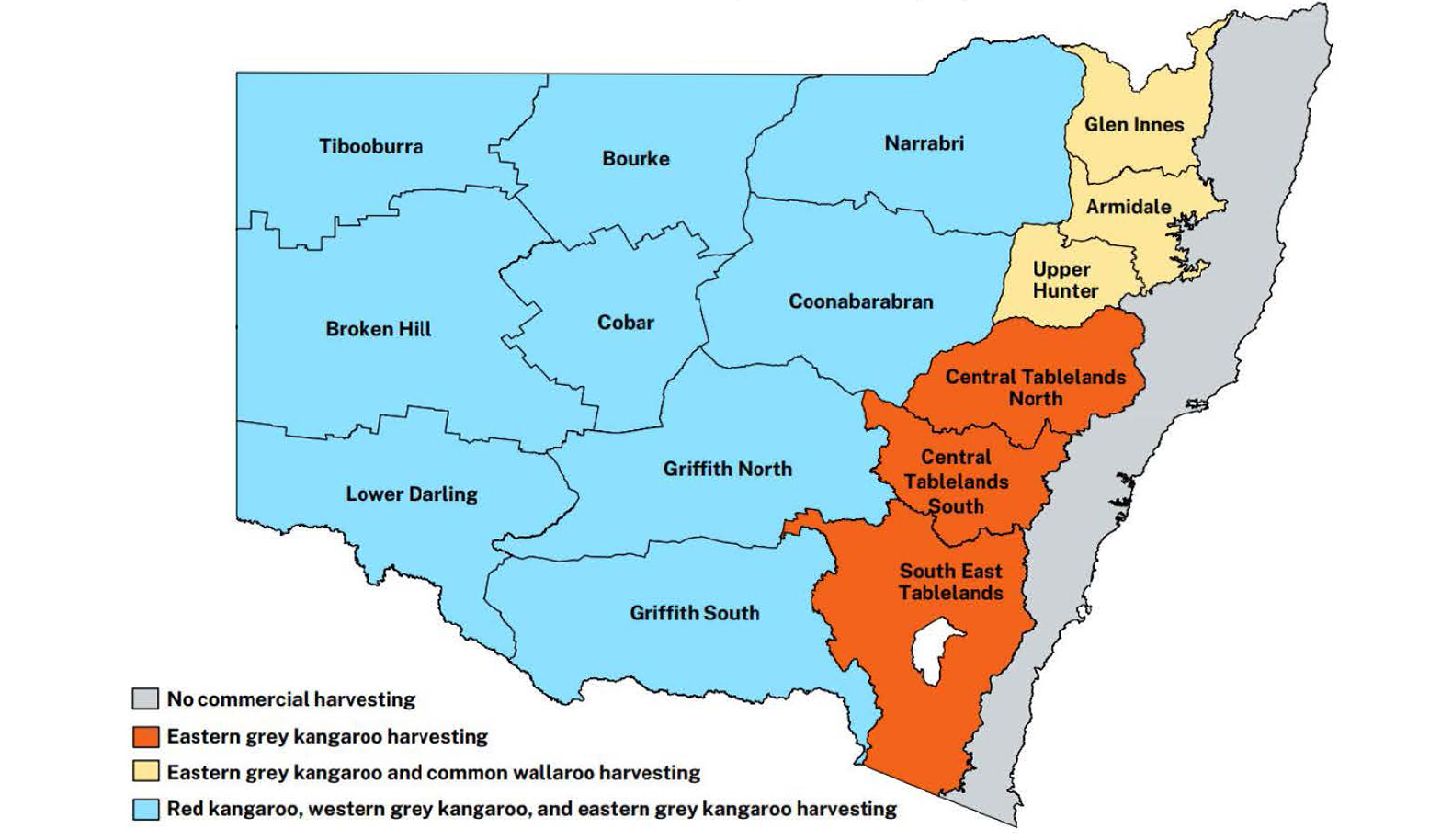
CONTEXT: While the New South Wales Government should be commended for establishing the inquiry, what occurred in the final instance can only be described as shocking, the significant watering down of the draft report (by politicians from the Labor, Liberal and National Parties), removing critically important recommendations, and the subsequent signing off of the New South Wales Government’s Wildlife Trade Management Plan for the Commercial Harvest of Kangaroos in New South Wales 2022-26 (so criticised by the inquiry). New South Wales Environment Minister at that time, Matt Kean, despite what we all knew about the utter mess that Kangaroo ‘management’ in New South Wales was in, signed off the management plan, passing it to the then Commonwealth Environment Minister, Sussan Ley, who also signed off on the plan on 22 December 2021.
Commercial shooting zone map courtesy of DCCEEW .
“So let’s discuss the numbers and the serial and ongoing decline in take on the Australian mainland. In 2002 the actual commercial take (excluding all the extensions which occurred after 2002) was 3,898,716, by 2024 this had fallen to 1,316,573, extensions included. The decline is not a function of lack of demand”. Peter Hylands
Peter Hylands, the Nature Knowledge Channel, recently engaged in correspondence with the New South Wales Department of Climate Change, Energy, the Environment and Water (DCCEEW) following a series of questions Peter put to NSW’s Environment Minister, Penny Sharpe. The department’s reply arrived in the form of a courteous and email, describing a robust regulatory framework that governs the commercial exploitation of Kangaroos in NSW, and by extension, the state’s approach to wildlife management.
DCCEEW stated that for half a century, the commercial exploitation of Kangaroos in NSW has operated under strict regulation, overseen by the Biodiversity Conservation Act and a wildlife trade management plan accredited at the national level. They explained that ‘only four abundant Kangaroo species’ are permitted to be exploited for commercial gain, each managed within carefully monitored zones. Regular population surveys inform the commercial quotas, which are capped at no more than 17 percent of the estimated population per species, per zone, standards, the department assures, that are designed to ensure ecological sustainability and humane practice. In support, they cited the recent review by biometricians from the University of St Andrews, who characterized the program’s survey methods as the most robust and up-to-date available.
The NSW government claim that the regulatory process is working. Kangaroo populations, ‘though naturally variable with Australia’s erratic weather cycles’, are not, they claim, being systematically depleted by commercial exploitation. Over the past decade, the government maintains, commercial take has never exceeded six percent of the estimated population in any given year. Even at its recent high in 2025, the total number of Kangaroos taken for commercial purposes was only a fraction of allowable quotas, suggesting that take is ultimately driven more by market demand than by regulatory shortcomings. The government emphasises its ongoing commitment to scientific monitoring and program improvement across the Kangaroo management program.
DCCEEW:
“Kangaroo populations naturally fluctuate in response to seasonal conditions, particularly rainfall and feed availability. Major declines are typically associated with drought. Harvesting, by contrast, has had little impact on populations, accounting for less than 6 per cent of the total estimated Kangaroo population in any year over the past ten years”.
Peter Hylands:
“The problem here is that if the population estimates are overstated, which in NSW they are, then your 6 per cent of the population becomes a number that is greater. Kangaroos also have a reproduction rate, this differs slightly by species, and that limits population increases. The maths are simple and they do not concur with your population estimates”.
Peter Hylands’ response is shaped by decades of close observation and research, coupled with an enduring concern for both the transparency and scientific validity of official wildlife management practices in Australia. He describes seeing the consequences of these policies not just on Kangaroo populations, but also on the communities, humans (including young children) and animals, affected by commercial exploitation, extending his concern nationally beyond NSW.
In his reply, Peter Hylands describes DCCEEW’s email as another example of government communications that, while reassuring in tone, fail to directly address specific questions and concerns. He argues that the official responses he and other members of the public receive are recursive and formulaic, providing assurances that may comfort the uninformed, but which do not fully reflect the reality of what is actually occurring.
Peter Hylands points to a broader pattern which includes recent government inquiries, such as the 2021 NSW Kangaroo Inquiry, which ultimately saw their initial findings reshaped and what remained in terms of recommendations ignored, with meaningful recommendations dismissed in favour of the status quo. Peter Hylands highlights the expansion of Kangaroo shooting zones across the mainland over recent years, in both NSW and neighbouring states such as South Australia and Victoria. These expansions, he argues, have not reversed the persistent downward trend in actual commercial take, a decline that cannot be attributed to lack of demand.
“The NSW Government held a Kangaroo Inquiry (established in 2021), chaired by NSW MLC Cate Faehrmann and in which Minister Penny Sharpe took part. In processes that were not dissimilar to the history of the development of government Kangaroo‘ methodologies’ the NSW Inquiry report was redrafted, its findings ignored as things carried on almost as before, and the CREEM report emerged. I have of course read both the reports for the ACT and NSW and did so as soon as I received them. I am not unfamiliar to the education and research systems in Scotland and following the CREEM report I did ask a series of questions to the Centre for Research into Ecological and Environmental Modelling at St Andrews, and not specifically related to NSW, about their assumptions, and on more than one occasion. There has been no response”. Peter Hylands
Through his detailed analysis, Peter Hylands observes an ongoing disconnect between quota allocations and actual take. He notes that in 2002, the commercial harvest across the mainland stood just under four million Kangaroos. By 2024, even after multiple shooting zone and species expansions, the number had dropped to around 1.3 million. Figures from South Australia reinforce his concerns; if not for recent extensions, actual take there would have been only11 percent of quota in 2025. He questions whether government-funded bounties and subsidies intended to boost commercial take are based on a flawed premiseand are being implemented without sufficient transparency.
To describe someof the absurdity of the population estimates, here is just one example, this time in the Griffith North shooting zone and population estimates for the Red Kangaroo.
"So we get a near ten-fold increase in the population in 12 months, that is an increase of 341,952, when the maximum possible assuming the Kangaroos all led a peaceful and safe existence (the very opposite is the case) is 3,600. So where did theadditional 338,352 Red Kangaroos come from? The NSW Inquiry highlighted these issues yet this still occurs”. Peter Hylands
Peter Hylands’s most trenchant critique targets the reliability of the population estimates that underpin quota-setting. He presents examples of drastic, biologically implausible year-on-year fluctuations in Kangaroo population estimates, such as the nearly tenfold increase in the Red Kangaroo population of the Griffith North shooting zone over a single year, raising fundamental questions about the validity of the data on which management decisions are made. As he points out, if population estimates are inflated, the percentage of the population being harvested may be far greater than government figures indicate, undermining claims of sustainable management.
Moreover, Peter Hylands calls attention to unresolved issues of animal welfare, describing the cruelty documented in the commercial exploitation of Kangaroos as among the worst he has observed internationally, an ethical dimension he regards as chronically sidelined in the broader policy debate.
The exchange between Peter Hylands and the NSW department exemplifies the persistent tensions in Australian wildlife management: between official narratives of sustainability and the observations, research and analysis of those impacted by the commercial trade in wildlife; between the need for transparency and the reality of contested data; and between shifting government policies and the lived consequences for biodiversity and animal welfare on the ground. For individuals engaged in ecology, public administration, and environmental policy, this dialogue illustrates both the complexity and the need for reconciling conservation with the entrenched cultural and political dogma that is constantly proffered by government in the treatment of Australia’s iconic fauna.

The population estimate for Kangaroos in New South Wales has fallen to 9,586,809 from 13,910,688, resulting in a decline in commercial quota for 2026 of 733,927 Kangaroos.
At a time of very significant climate events the Government of New South Wales is killing an increasing number of protected native animals using its Harms Permit System, that is just on half a million in 2025.
1980-2026: This analysis provides an update of the population estimates, quotas and actual kill for commercially exploited Macropods in shooting zones by state and all Australia mainland.
What happened, the New South Wales Government Inquiry into the Health and wellbeing of Kangaroos and other Macropods in New South Wales?