Gun culture and crime and its impact on native species in regional Victoria

Life on land


Your support will assist us to continue our research and content development, the greater our resources, the more we can do.
The more we have an accurate understanding of what is happening to nature, the more we can all do to protect what remains of our living planet.
This is also an opportunity for philanthropists to be part of an ongoing project that tells independent stories about the natural world, stories that will help us to better understand what is happening to species and places on our precious planet Earth.
Note: Creative Cowboy Films does NOT have tax deductible charity status.
Becoming a member of Creative cowboy films The Nature Knowledge Channel is a very real way you can help the precious natural world and support the work we do in creating knowledge about what is happening to it.

The Nature Knowledge Channel is a very real way you can help the precious natural world and support the work we do in creating knowledge about the natural world.
Annual membership of the Creative cowboy films - Nature Knowledge Channel gives you full access to content, stories and films, available on this website. Becoming a member of the Creative cowboy films - Nature Knowledge Channel is a very real way you can help the natural world and support our work in creating a greater understanding about what is happening to it.
A point of difference
Creative cowboy films is independent, is not funded by governments or industry, and is not influenced by their associated interest groups. For reasons of independent research and content development, Creative cowboy films does NOT have tax deductible charity status.
Life on land
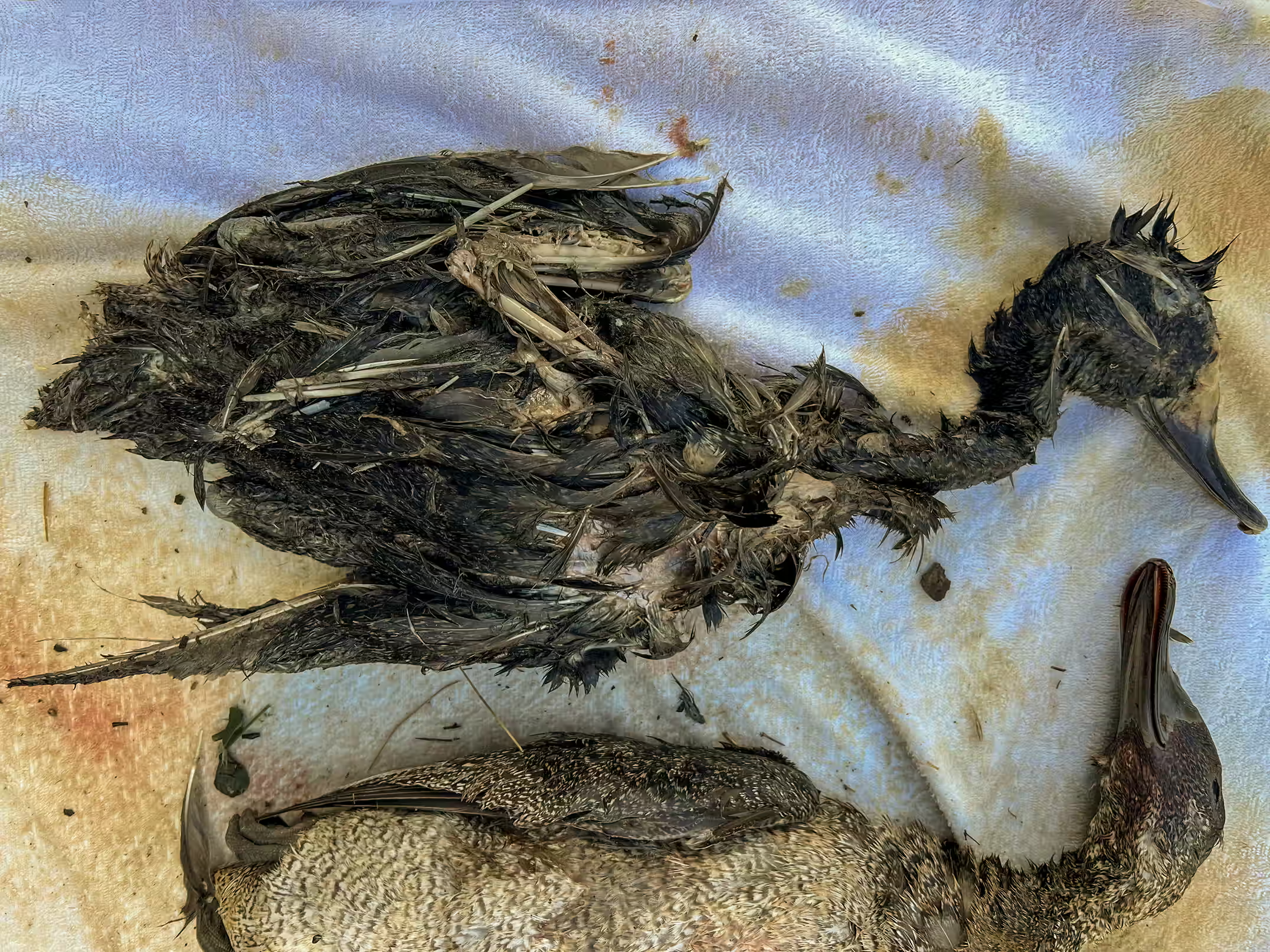
CONTEXT: Recent developments in gun control policy in Victoria have raised significant concerns regarding the safety of communities, the integrity of public administration, and the protection of Australia’s native wildlife. Despite recommendations made following major national security incidents, including the Bondi terror attack and a high level of domestic violence, the Victorian Government has decided against introducing caps on the number of firearms an individual may own. This decision has drawn criticism from a range of animal welfare organisations, particularly in light of escalating firearm-related tragedies, including the fatal shooting of two police officers in Porepunkah in August 2025. Policies which facilitate gun ownership, rather than restricting it, only serve to increase risk within the state.
Over nearly half a century, our experience with gun crime in Victoria has been extensive. In the recent period, particularly since 2014, reluctance by the Victorian Government to align with national efforts toward stricter gun control has occurred while the Victorian Government’s strategy has been to develop a gun culture in the state. This, despite the Australian Government’s stated intention to introduce more robust firearm regulations, the Victorian Government appears to be pursuing a divergent strategy, one that seems to emphasise the promotion of hunting and shooting activities within the state. This shift towards branding Victoria as the ‘hunting state’, one might ask whatever happened to the ‘education state’? It is our assessment that this signals a broader unwillingness to implement the full spectrum of sensible firearm reforms recommended at the federal level, the beginnings of this process are now evident.
This position has become particularly apparent following the recent review into Victoria’s gun laws, commissioned after the Bondi terror attack. Led by former police commissioner Ken Lay, the review presented 16 recommendations for strengthening gun control, including the imposition of a cap on the number of firearms allowed per licence holder. Specifically, the review recommended limiting ownership to a maximum of four firearms per individual. This recommendation was grounded in the findings that the average Victorian licence holder possesses four firearms, while a significant proportion of licence holders do not own any at all. Furthermore, licensed firearm owners constitute only around four percent of Victoria’s total population.
Despite these findings and the report’s call for a nationally consistent approach to firearm regulation, the Victorian State Government has chosen not to implement the proposed cap on firearm numbers. Premier Jacinta Allan publicly rejected this particular recommendation, arguing that such a measure would not effectively address the issue of criminal misuse of firearms or target “bad actors.” This policy stance is consistent with the government’s broader approach, which prioritises local interests in shooting over the advancement of comprehensive public safety reforms.
It is important to recognise that this decision has wider implications, not only for human safety but also for the wellbeing of Victoria’s native species. Easier access to firearms and higher rates of gun ownership can facilitate illegal and unregulated shooting, which poses significant threats to native wildlife populations across regional Victoria. Experiences in other jurisdictions indicate that inadequate gun control can directly and indirectly increase pressures on vulnerable species, exacerbate poaching, and undermine conservation efforts. Accordingly, the reluctance to strengthen firearm regulation jeopardises not only efforts to curb gun crime but also the protection of our region’s unique biodiversity. As such, a nationally coordinated policy response remains essential if we are to safeguard both public safety and environmental integrity across regional Victoria.
"Claims that guns can be kept away from criminals are nonsense speak".
Gun culture in Victoria appears to be embedded, not only in rural communities, but also in urban areas, with nearly one million registered firearms and an unknown number of illegal weapons in circulation. This proliferation is not merely a matter of public safety; it also has profound implications for the environment and those who earn their livelihoods from it. A notable trend in policy has been the expanding scope for commercial and recreational hunting, including on public land, with limited community consultation or consideration of business interests in adjacent properties. The capture of public land by shooters in Victoria, while excluding the general public from these public and supposedly conservation lands, is now significant. These decisions place additional strain on local economies that depend on nature tourism or environmentally responsible businesses and particularly affect professional women and older property owners.
“In our very significant experience in these matters of environmental and rural crime in Australia, it is often professional women and older people that suffer the most from the Victorian Labor Government’s conduct”.
The ongoing liberalisation of gun-related regulations is occurring in direct contradiction to federal measures seeking to reduce gun-related crime and preserve Australia’s unique biodiversity. Of particular concern is the Victorian Government’s active promotion of hunting as a recreational activity, even among children as young as 12 years old and even on Ramsar Sites and in National Parks (commercial). The cumulative impact of these policies is evident in recent figures on lethal control of native wildlife. In 2025 alone, Victorian Government-issued Authorities to Control Wildlife (ATCWs) targeted 230,673 protected native animals, a figure 2.5 times greater than in 2022. Since 2009, more than 53,000 permits have been issued, resulting in the targeted killing of nearly 2.5 million native animals. Taking into account all the ways in which protected native species can be legally killed in Victoria, the majority are shot, more than one million native animals are now killed each year.
The scale of sanctioned wildlife destruction is significant. Victoria’s public land comprises approximately 32 per cent of the state’s landmass (around 7.3 million hectares), with hunting permitted on about 18 percent of the total state area, equating to 55 per cent of all public lands. Emerging policy changes are expected to further expand hunting rights both on public and private land. Conservative estimates suggest that 40 to 50 per cent of Victoria’s entire landmass could be subject to hunting activities targeting both protected and introduced species, in turn endangering visitors to these public places.
These figures underscore the extent to which current policies prioritise certain commercial and recreational interests over the protection of Victoria’s environmental assets and public safety. A new approach, one informed by principles of tolerance, social justice, and ecological responsibility is urgently required. The evidence is clear, that is, Victoria’s gun culture is becoming both more entrenched and more detrimental to the state’s social and environmental fabric.