Harms permits in New South Wales

Life on land


Your support will assist us to continue our research and content development, the greater our resources, the more we can do.
The more we have an accurate understanding of what is happening to nature, the more we can all do to protect what remains of our living planet.
This is also an opportunity for philanthropists to be part of an ongoing project that tells independent stories about the natural world, stories that will help us to better understand what is happening to species and places on our precious planet Earth.
Note: Creative Cowboy Films does NOT have tax deductible charity status.
Becoming a member of Creative cowboy films The Nature Knowledge Channel is a very real way you can help the precious natural world and support the work we do in creating knowledge about what is happening to it.

The Nature Knowledge Channel is a very real way you can help the precious natural world and support the work we do in creating knowledge about the natural world.
Annual membership of the Creative cowboy films - Nature Knowledge Channel gives you full access to content, stories and films, available on this website. Becoming a member of the Creative cowboy films - Nature Knowledge Channel is a very real way you can help the natural world and support our work in creating a greater understanding about what is happening to it.
A point of difference
Creative cowboy films is independent, is not funded by governments or industry, and is not influenced by their associated interest groups. For reasons of independent research and content development, Creative cowboy films does NOT have tax deductible charity status.
Life on land
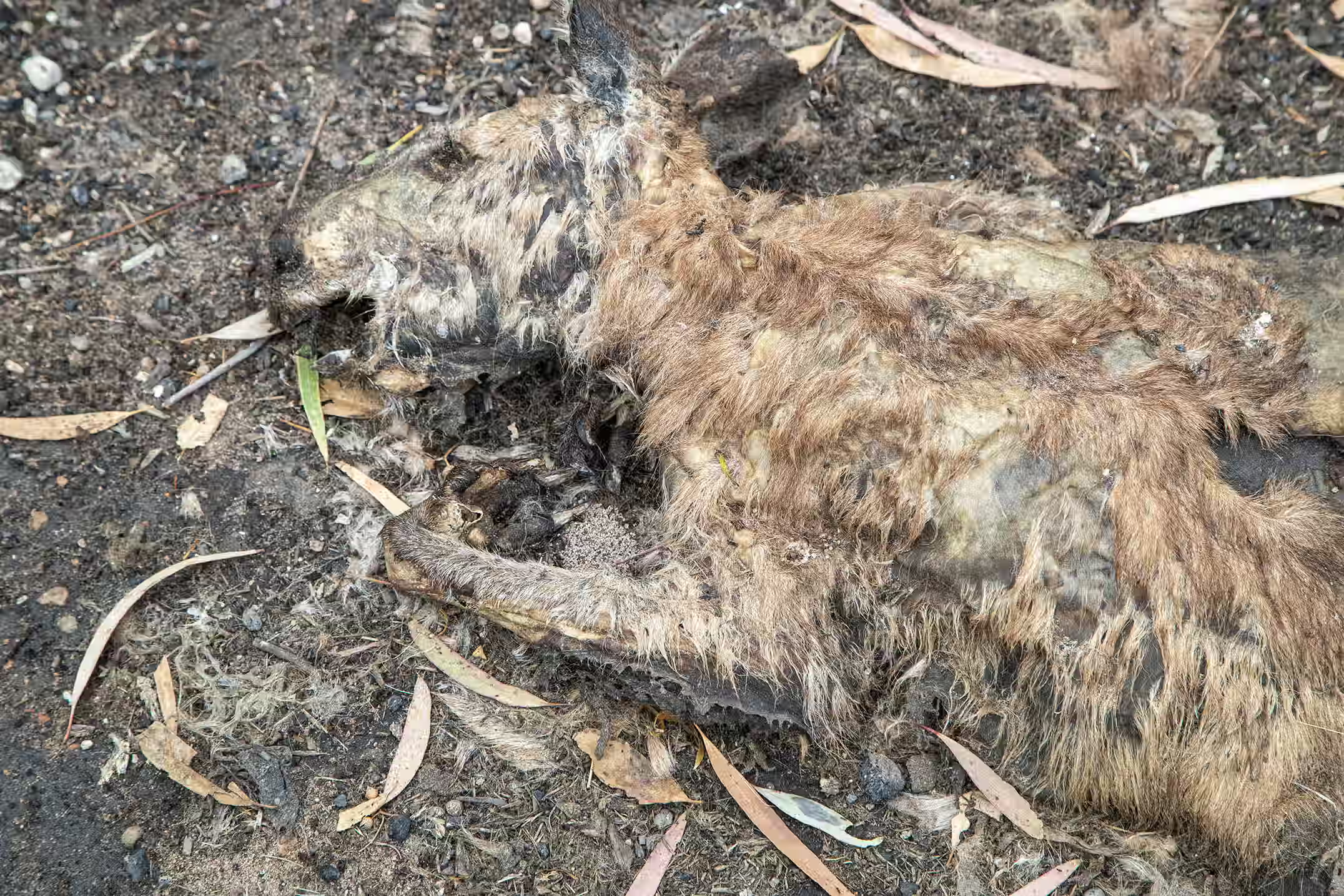
At a time of very significant climate events the Government of New South Wales is killing an increasing number of protected native animals using its Harms Permit System, that is just on half a million in 2025.
What is evident in all states is that the cumulative impact of state government behest protected wildlife killing is not considered across its many forms, which include commercial exploitation, recreational killing, harms and mitigation permits, unprotection and secret killing regimes (which include Koalas).
Nor are the impacts of climate change and large scale development, including third world scale land clearing for agriculture, mining and construction considered and this is where a very large number of protected native animals also die (in the hundreds of millions). So a long line of silos, each silo with a great many dead protected Australian animals, who can no longer tell their story. It is the incompetence and devious nature of it all that is so shocking.
In the recent period the New South Wales Government has reported (via its Inquiry into licences to harm native animals) that:
Over the same period in New South Wales a large number of Kangaroos were killed for commercial gain (the figures do not include joeys):
In 2023, the Nature Knowledge Channel analysed a New South Wales Government ‘dump’ of harms permits on its website. This took several days. The analysis gave the number of harms permits by species for the period from 2018 to 2022. The total kill from that analysis by the New South Wales Government via its harms permits in the period was as follows:
2018 – 928,361 – Wildlife and politics, this was the year the New South Wales Government thought that it would gain votes by promoting the mass killing of Australian wildlife in regional communities prior to the 2019 state election. Kangaroos suffered very badly as a result and particularly so in 2018 and 2019.
In the period 2018 to 2022 and a large number of Kangaroos were also killed for commercial gain:
All of it a deeply shocking way in which an Australian state has chosen to treat its wildlife. What is even more shocking is that each and every state in Australia does a similar thing.
We send out the same warnings to environment ministers in Australia year after year. In a small group of leading nations when it comes to the rate of extinctions, Australia tops the list when it comes to mammal extinctions, the list of extinct, regionally extinct, critically endangered, endangered and threatened species is long and getting longer by the day. Australian species cannot sustain the slaughter and killing at scale because of climate change and development.
The tipping point is near.
Three years ago, Australia agreed to adopt the Kunming-Montreal Global Biodiversity Framework (GBF). The GBP supports sustainable development in order to stop and reverse the loss of biodiversity, enabling the world to live in harmony with nature by 2050. One of the targets which is known as Target 18 is meant to eliminate, phase out or reform annual incentives that harm biodiversity.
The way it is going in Australia and by 2050 there will be nothing left. For 2025 early figures show that government behest killing of protected Australian wildlife will top 5 million animals. Australian State and Federal Government incentives, which include bounties, subsidies, international marketing of a wildlife trade, surveys, grants that further enable and encourage hunting of native species, including product promotions, expensive inquiries that go nowhere and endless government reports that try to justify the mass killing of wildlife at government behest. And there is an army of public servants that spend a great deal of time trying to defend the status quo because they believe that is what is required of them. Leadership someone please.

Licences to harm are non-commercial permits and with few exceptions are issued to kill protected Australian species in NSW.
In 2021 in Victoria, just 2.6 per cent of the permits issued to ‘control’ Australian wildlife were for non-lethal control.
An alarming increase in native wildlife killing in 2023. During 2023, 2,482 ATCW permits were issued to lethally control 119,367 native Australian animals in Victoria (Australian mammals and birds).
This analysis details the number of ATCWs issued in Victoria in 2024 by species and number of animals targeted. It shows a significant increase in the number of protected wildlife being killed using this permit.
This analysis is a rebuild of annual Kangaroo population estimates, commercial quotas and actual take from 1980, including the population estimate data removed from the public gaze.
In Tasmania in 2024 there were 4,278 active Property Protection Permits resulting in an actual reported take of Australian protected species of 633,953 animals.