2026: Duck shooting update Victoria, Tasmania and South Australia

Life in the air


Your support will assist us to continue our research and content development, the greater our resources, the more we can do.
The more we have an accurate understanding of what is happening to nature, the more we can all do to protect what remains of our living planet.
This is also an opportunity for philanthropists to be part of an ongoing project that tells independent stories about the natural world, stories that will help us to better understand what is happening to species and places on our precious planet Earth.
Note: Creative Cowboy Films does NOT have tax deductible charity status.
Becoming a member of Creative cowboy films The Nature Knowledge Channel is a very real way you can help the precious natural world and support the work we do in creating knowledge about what is happening to it.

The Nature Knowledge Channel is a very real way you can help the precious natural world and support the work we do in creating knowledge about the natural world.
Annual membership of the Creative cowboy films - Nature Knowledge Channel gives you full access to content, stories and films, available on this website. Becoming a member of the Creative cowboy films - Nature Knowledge Channel is a very real way you can help the natural world and support our work in creating a greater understanding about what is happening to it.
A point of difference
Creative cowboy films is independent, is not funded by governments or industry, and is not influenced by their associated interest groups. For reasons of independent research and content development, Creative cowboy films does NOT have tax deductible charity status.
Life in the air
Context: Economics
Victoria’s State finances are in a difficult place and it seems entirely inappropriate that large amounts should be spent on significant and pointless wildlife killing activities, including birdlife and the negative economic issues relating to recreational duck shooting.
Tourism Research Australia data shows that tourists who birdwatch spend around $2.9 billion in a given year. In 2021, the Victorian Parliamentary Budget Office found that Duck shooting contributed $10 million to Victoria, most of the benefit flowing to Melbourne. This does not account for climate change costs from vehicles, the fact that all equipment is likely to be imported (including vehicles, fuel, tents and other equipment), helicopter surveys, consultants, modelling and reports, costs of law enforcement, costs of the Game Management Authority (GMA), cost of public servants and politicians defending the mass killing of birdlife, costs imposed on the majority opposing the killing and losses from unrealised tourism opportunities (including from the state’s Ramsar sites) and the destruction of amenity (which is very stressful and disruptive of work and leisure) of local residents near the shooting activity.
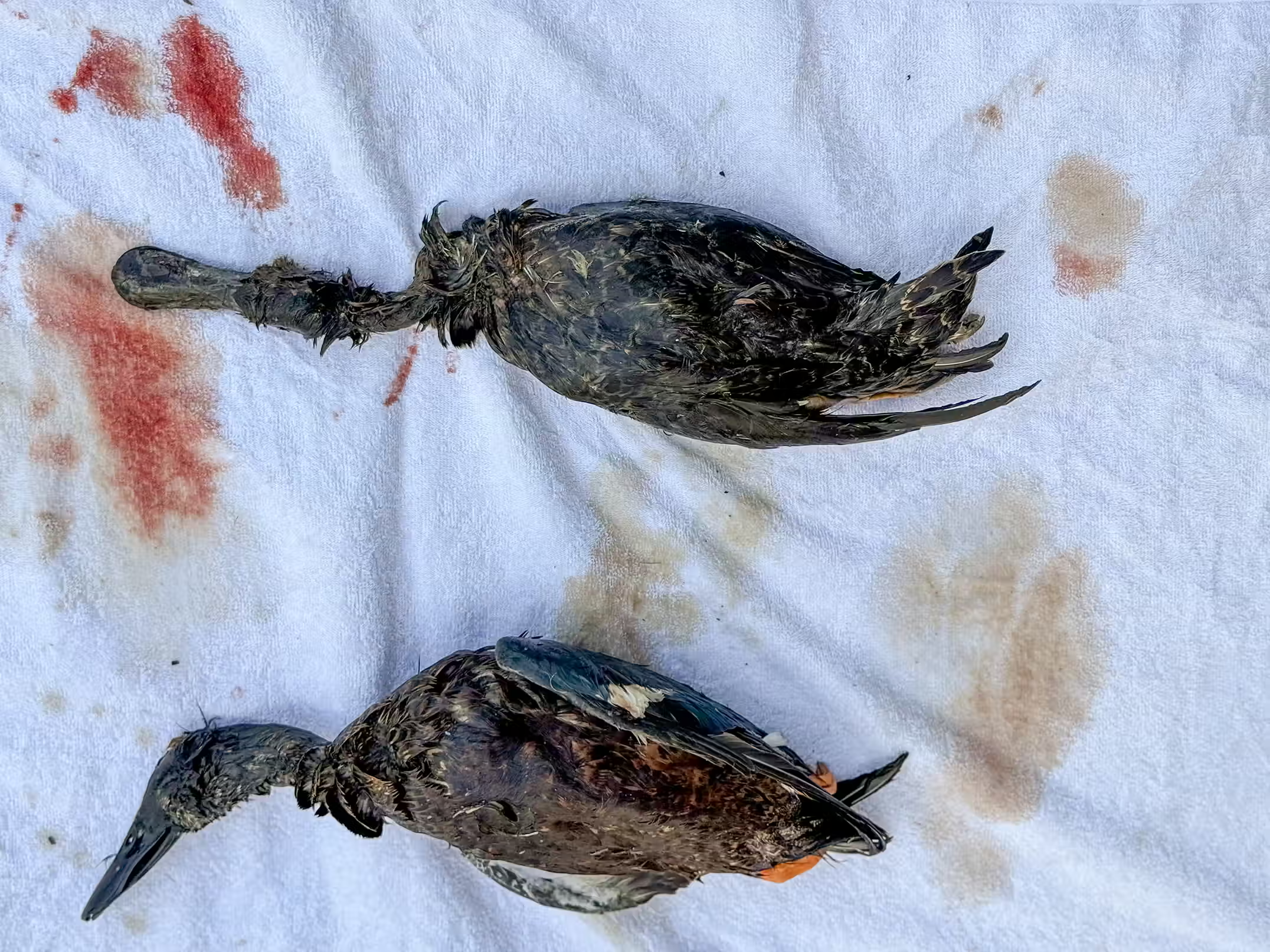
There are significant costs which are imposed on individuals and animal organisations as they rescue and rehabilitate injured wildlife, often facing heavy fines and malicious prosecutions for doing so. The general public pick up the bill for the Victorian Government’s conduct in these matters.
And what about 2026? The policing effort aimed at the general public grows ever larger year on year, an abuse of public finances.
What did Regional Victorians opposed to duck shooting Inc have to say about the first weekend of shooting following the mid-week opening?
“The thought of how much public money has been poured into government promotion of this year's duck shoot is acutely painful. More officers than ever were deployed around the state - from GMA, Vic Police, Parks Victoria, even Forest Fire Management Victoria. Were they monitoring shooters though, or members of the public who are not permitted to enter many public areas because they don't shoot ducks? (It's true, unless you have a licence to shoot native birds you are not permitted to enter many public areas. What a fabulous interpretation of Victoria's Charter of Human Rights.)
And helicopters were again chartered by GMA - we are told for "compliance monitoring". It's difficult to understand how they can do anything about illegal shooters from the air. But they certainly succeeded in terrorising stock and pets when circling over residents' homes, seemingly oblivious to the shooters 800m away”.
In this analysis we discuss recreational Duck shooting in three states, Victoria, the most egregious, all too often violent and out of control, South Australia and Tasmania. The numbers do not include other reasons for killing birdlife, including commonly used ‘mitigation' permits.
New South Wales also permits recreational shooting of protected Australian duck species on private land although duck shooting in the state is ‘banned’ and probably accounts for the death of an additional 30,000 - 40,000 or so Ducks per annum’ as does the Northern Territory which has an ‘official’ season accounting for another 200,000 or so ducks each year. It is the total disregard for animal welfare that is so chilling.
The scale of it all is shocking. The standards of governance in Victoria in particular are appalling and need special mention.
“Rescuers are being targeted because they carrying something to help, not harm wildlife, the Game Management Authority (Victoria) is now using a technicality under the wildlife game regulations to remove licenced rescuers because they carry a net instead of a gun and a net is not an approved hunting weapon. Shooters not only illegally shot early at Lake Leaghur (a Ramsar wetland), they failed to retrieve wounded birds which plunged into dense vegetation before shooting more. For wounded birds death is guaranteed but wounded birds are also often still highly mobile and a net is required to capture them. When Manfred, a licenced rescuer and wildlife carer reported this illegal activity by shooters to the Game Management Authority, they instead confiscated his net and suspended his licence”. Georgie Purcell MP
In Victoria we imagine, that when it comes to knowledge and law, there might be some idea of how democracies work. Too many Victorians are finding out the hard way that this idea is a very long way from the truth.
“After a marathon three-hour meeting on Monday, cabinet rejects a recommendation from a Labor-led parliamentary inquiry to ban the divisive practice, which would have brought the state into line with New South Wales, Western Australia and Queensland” Guardian 30 January 2024.
In 2026 Duck shooting in Victoria began at 8am on Wednesday 18 March and will close 30 minutes after sunset on 8 June.
Shooters are allowed to kill a maximum of nine ducks per day.
Shooter are not allowed to kill the ‘protected’ Blue-winged Shoveler.
Hunting is allowed between 8:00am until 30 minutes after sunset for the first five days (18-22 March, inclusive), then from 30 minutes before sunrise until 30 minutes after sunset for the remainder of the season.
Seven ‘protected’ Australian duck species are being killed for ‘recreation’ in 2026. These are:
The Blue-winged Shoveler cannot be hunted.
“Regulations require hunters to make all reasonable efforts to immediately retrieve all downed game ducks and to salvage at least the breast meat from all harvested ducks”. Victorian Government
When the gloves really came off. The Wildlife (Game) Regulations were remade in September 2024 and resulted in some changes to how duck hunting occurs in Victoria. Changes include:
The 2023 South Australian Parliamentary inquiry into native bird hunting recommended continuing recreational duck shooting, despite acknowledging significant animal welfare issues and public opposition. The report favoured tightening regulations over a ban, rejecting findings from a similar Victorian inquiry. The state government continues to permit the killing of ‘protected’ Australian Duck species in the state.
Duck shooting began at sunrise on Saturday 21 March 2026 (the day of writing) and will end at sunset on Sunday 28 June 2026. Some ‘Game Reserves’ have restricted dates for the 2026 open season.
In the dryest state in Australia, several Ramsar-listed wetlands in South Australia are designated as or contain game reserves allowing duck shooting to occur. These are Chowilla Game Reserve within the Riverland site, Bool Lagon Game Reserve and several reserves within the Coorong and Lakes Alexandrina and Albert site, including Tolderol, Mud Islands and Currency Creek Game Reserves.
Shooting is allowed between sunrise and sunset on any given day of the open season at approved locations.
In 2026 the following five protected Australian species can be shot in South Australia are:
The protected Australian species in South Australia which cannot be shot in 2026 are:
One wonders what they think when the South Australian Government’s public servants comes up with this nonsense ‘The taking of eggs of any duck species during the open season is prohibited”.
Dead ducks cannot look after eggs or their ducklings so it might be best to stop the killing.
Bag limit: 8 ducks per day per shooter.
Protected Australia Ducks can be shoot in Game Reserves, on some unalienated Crown land and on private land or dedicated Crown land with the written permission of the landowner.
“Each February since 1985 the Department carries out a state-wide count of waterbirds with assistance from the Parks and Wildlife Service and many volunteers. These counts are not an attempt to count all of the Ducks in the state but rather to get an index of trends in the populations”. Tasmanian Government
Duck shooting commenced 7 March 2026 and ends 8 June 2026.
Protected Australian Duck species that can be shot in Tasmania in 2026 are:
All other species must not be shot.

Based on a mixture of actuals and estimates based on previous years, the number of ducks likely killed in Australia's duck shooting states in 2023 was 424,000. Including the Northern Territory the number rises to 657,170.
More than 250 dead waterbirds, including threatened species, were displayed outside the Victorian Premier’s office on 1 April.
The South Australian Government’s Duck shooting inquiry fails to deliver any positive change and Victoria, after its inquiry, strides determinedly down the same path.
In 2018 we made extensive trips through South Australia and up into the Northern Territory.
The Tasmanian State Government said it had no plans to ban recreational duck hunting.
As duck populations plummet the number of ducks being shot in New South Wales in 2023-24 by ‘responsible volunteer hunters’ near doubles.