Victoria: Number of Authorities to Control Wildlife (ATCWs) protected Australian species 2025 and cumulative since 2009

Life on land


Your support will assist us to continue our research and content development, the greater our resources, the more we can do.
The more we have an accurate understanding of what is happening to nature, the more we can all do to protect what remains of our living planet.
This is also an opportunity for philanthropists to be part of an ongoing project that tells independent stories about the natural world, stories that will help us to better understand what is happening to species and places on our precious planet Earth.
Note: Creative Cowboy Films does NOT have tax deductible charity status.
Becoming a member of Creative cowboy films The Nature Knowledge Channel is a very real way you can help the precious natural world and support the work we do in creating knowledge about what is happening to it.

The Nature Knowledge Channel is a very real way you can help the precious natural world and support the work we do in creating knowledge about the natural world.
Annual membership of the Creative cowboy films - Nature Knowledge Channel gives you full access to content, stories and films, available on this website. Becoming a member of the Creative cowboy films - Nature Knowledge Channel is a very real way you can help the natural world and support our work in creating a greater understanding about what is happening to it.
A point of difference
Creative cowboy films is independent, is not funded by governments or industry, and is not influenced by their associated interest groups. For reasons of independent research and content development, Creative cowboy films does NOT have tax deductible charity status.
Life on land
CONTEXT: Kangaroos
For Western and Eastern Grey Kangaroos, the numbers here describe allocations that reverse the Victorian Government’s policy of shifting ATCW permits to commercial permits. This reversal of policy also occurred in 2024.
We should note that the Victorian Kangaroo killing system requires that commercial kills are accounted for and reported, ATCW kills, once the ATCW permits are issued, have no reporting requirement. So for ATCW permits issued, the Victorian Government does not have a clue about what actually happened. Failure to meet commercial quotas is very telling and describes hyper-inflated Victorian Government Kangaroo population estimates, so shifting more permits across to ATCWs means no one knows what actually happened.
The large number of ATCWs now being issued in Victoria for the Red Kangaroo and Western Grey Kangaroo further endanger the state’s populations of these species, driving them ever closer to extinction in the state.
The Victorian Government does not track what occurs after ATCW permits are issued and therefore does not know how many animals were actually killed, either more or less. Nor does the Victorian Government track animal welfare standards in relation to ATCW permits.
We should understand that ATCWs are not the only mechanism by which protected Australian species can be killed in Victoria, other enabled Victorian Government killing mechanisms include unprotection, secretive killing by Ministerial order, commercial and recreation, in total government data shows that 1,158,000 protected Australian animals were killed (or targeted) in Victoria in 2024, more than in any other Australian state in that year.
As the number of protected Australian species and the number of animals being targeted year on year grows rapidly, absolutely no account has been taken of a series of government inquiries regarding the natural world and biodiversity at both Victorian Government State and Commonwealth Government level, and worse still, no account of the major and catastrophic climate related disasters in the state accounting for the death of several million native animals. The situation in Victoria regarding the mass killing of wildlife is now completely out of control.
Recent direct threats to biodiversity in the state, since 2018 the Victorian Government has been and attempting to block wildlife rescues from climate events (floods and fires), including when large numbers of protected Australian species were at extreme risk or suffering very badly from their injuries. Added to this a very significant increase in ’burning off’ in Victoria’s forests, methods include burns ignited from helicopters, no care is taken to check if animals are present. Indiscriminate poisoning at scale also has a major impact well beyond target animals, and despite claims from government to the contrary, all of these threats continue at scale and are likely to intensify.
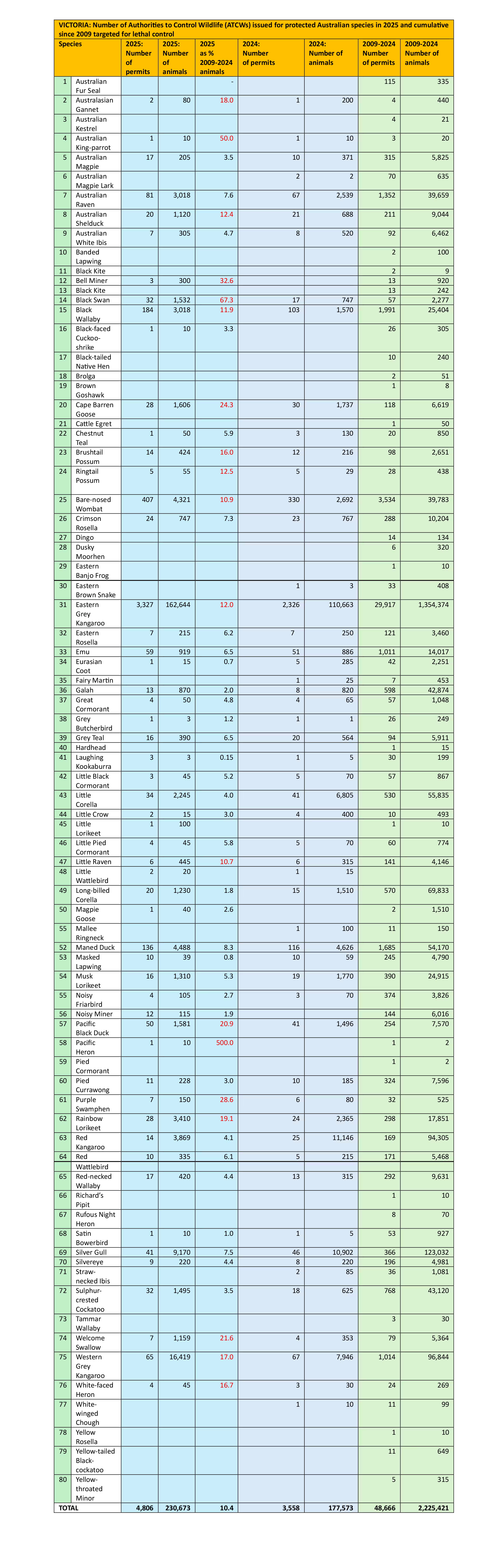
In 2025 the Victorian Government issued 4,806 Authority to Control Wildlife Permits (ATCWs) for the lethal control of protected Australian species, this compares with 3,558 permits issued in 2024, 2,482 permits in 2023 and 2,428 permits in 2022. The number of permits issued for lethal control of protected Australian species in 2025 was double the number issued in 2022.
Since 2009, including 2025, the Victorian Government has issued 53,472 ATCWs for the lethal control of protected Australian wildlife.
In 2025 ATCW permits for lethal control targeted 230,673 protected Australia native animals, in 2024, 177,573 protected Australia native animals were targeted, in 2023, 119,367 protected Australia native animals were targeted and in 2022, 90,301 protected Australia native animals were targeted. In 2025 the number of protected Australian animals targeted for lethal control was 2.5 times greater than in 2022.
Since 2009, including 2025, the Victorian Government has issued ATCWs for the lethal control of protected Australian wildlife targeting 2,456,094 animals. Since 2009, the average annual target is 144,476, in 2025 the protected Australian animals targeted for lethal control was 1.6 times the 17 year average since 2009.
Since 2009, 80 protected Australian species have been targeted for control, including numerous bird species. The table below provides the data for 2025 and 2024 and the cumulative data for 2009 to 2024 inclusive by protected Australian species.
Victoria, because of past behaviours, now has over 270 endangered and threatened vertebrate species, many hundreds more, when invertebrate species, plant species and other classes of life are considered. As of March 2025, over 2,000 species of plants, animals, and fungi were listed as threatened or endangered in Victoria, under the Flora and Fauna Guarantee Act 1988 (FFG Act). This means that almost one third of all of Victoria’s species are now in danger of extinction and the Victorian Government’s current conduct is only hastening their demise.
We have removed some species from the list as it is uncertain whether or not ATCW permits were issued for lethal or non-lethal control. If there is any non-lethal control data remaining in the stats below these would be very small in number and have no effect on the overall findings. We should note that, while claiming that every effort was made to ensure ATCW permits were issued as non-lethal permits, this turned out to be a very long way from the truth when the Victorian Government was made to publish the data, which showed for the first time, in 2021, that out of all the permits issued in that year by the Victorian Government, just 2.6 per cent of these permits were issued for non-lethal control. Flying Fox species in Victoria are impacted by large scale efforts to move them on, resulting in loss of young etc. This would be one example of what are now non-lethal ATCW permits which are being issued for large numbers of Flying Foxes. As a general comment, the death of young animals, joeys etc, is unlikely to be recorded or accounted for in any data.
In its 2026 Budget, the Victorian Labor Government did not add any new funding for Biodiversity 2037, which remains largely unfunded. Regarding the transition from Native Forest Logging in Victoria, the Victorian Auditor-General's Office (VAGO), found that there had been a complete lack of oversight for previous Budget items relating to the transition, including for example, the $1.35 million spent on ‘site rehabilitation’ grants that required no evidence of works completed or even attempted.
(Australia at 17 for the period at about 10 per cent of United States active users).

In 2024 and at the behest of state and territory governments in Australia, 4.6 million animals from around 70 ‘protected’ Australian species of mammals and birds were killed.
Despite the panel delivering its final report in December 2021, the Victorian Labor Government had not responded to the report until it published its response, Victorian Government response to the Wildlife Act Review, on 17 October 2025.
This story attempts to piece together the history of mass killing of native Australian species in State and National Parks in Victoria. Over 100,000 Kangaroos have been targeted since 1984, when the killing began.
This analysis details the number of ATCWs issued in Victoria in 2024 by species and number of animals targeted. It shows a significant increase in the number of protected wildlife being killed using this permit.
We visit the home of Australian explorers, Suzan and Jon Muir. Suzan Muir describes the terrible impact of fire on the property and its wildlife that Suzan and Jon love so much.
This report contains reflections on a trip in Western Victoria in June 2022.