Hattah-Kulkyne National Park, Victoria: Update on recent park closure for certain conservation activities

Life on land


Your support will assist us to continue our research and content development, the greater our resources, the more we can do.
The more we have an accurate understanding of what is happening to nature, the more we can all do to protect what remains of our living planet.
This is also an opportunity for philanthropists to be part of an ongoing project that tells independent stories about the natural world, stories that will help us to better understand what is happening to species and places on our precious planet Earth.
Note: Creative Cowboy Films does NOT have tax deductible charity status.
Becoming a member of Creative cowboy films The Nature Knowledge Channel is a very real way you can help the precious natural world and support the work we do in creating knowledge about what is happening to it.

The Nature Knowledge Channel is a very real way you can help the precious natural world and support the work we do in creating knowledge about the natural world.
Annual membership of the Creative cowboy films - Nature Knowledge Channel gives you full access to content, stories and films, available on this website. Becoming a member of the Creative cowboy films - Nature Knowledge Channel is a very real way you can help the natural world and support our work in creating a greater understanding about what is happening to it.
A point of difference
Creative cowboy films is independent, is not funded by governments or industry, and is not influenced by their associated interest groups. For reasons of independent research and content development, Creative cowboy films does NOT have tax deductible charity status.
Life on land
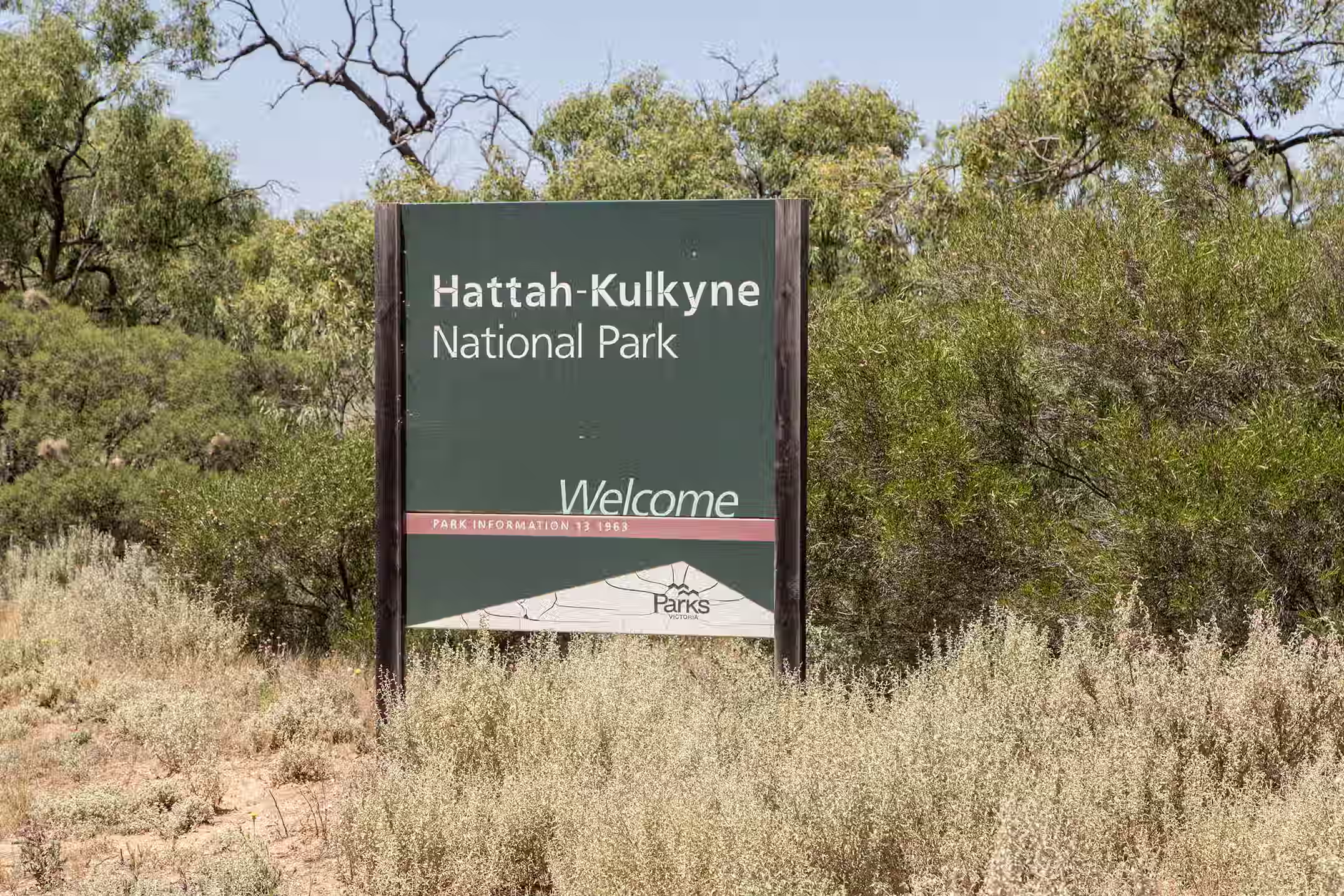
CONTEXT 2026: Parks Victoria rationale for killing Kangaroos in the Hattah-Kulkyne National Park in 2026.
During the most recent Kangaroo management operations at Hattah-Kulkyne National Park, 292 Western Grey Kangaroos and 85 Red Kangaroos were culled, remaining cull targets were 4,362 Western Grey Kangaroos and 1,602 Red Kangaroos. The estimated densities from the most recent surveys were 6,024 Western Grey Kangaroos and 1,824 Red Kangaroos. Target abundance representing the ideal ecological balance for regeneration is set at 1,370 Western Grey Kangaroos and 137 Red Kangaroos hence the need for culling to take place.
The reader should see comments relating the Hattah-Kulkyne National Park in this story as a position statement from Parks Victoria and not in any way commentary or analysis from the Nature Knowledge Channel. All the numbers in this story have been provided by Victorian Government organisations. The only comment I will make is that the very significant decline in Kangaroo populations in the Mallee Parks since 1984, when the mass killing began, is described by the difficulty the government has in meeting its kill targets. These parks once represented a place of safety for Red and Western Grey Kangaroos which are being eliminated outside of parks in Victoria and in the dwindling places that these species still exist. That is clearly no longer the case.
The background to this information is that I had asked Parks Victoria the reason why the Hattah-Kulkyne National Park was closed over a recent weekend for conservation activities. The answer, as per the initial response was as follows:
“My team undertook a feral goat control program during this period. As firearms were in use, the park was temporarily closed in the interest of public safety while the operation was carried out”.
I followed that up with questions relating to their intentions regarding the remaining Kangaroo and Wallaby populations in the Hattah-Kulkyne National Park.
What follows in this section is advice from the Chief Ranger provided to Peter Hylands 12 June 2026.
The Kangaroo management program at Hattah-Kulkyne National Park is designed to protect and restore the endangered semi-arid woodland vegetation community. This ecological community has been heavily degraded by past land use and is critical habitat for a range of threatened species, including the Pink Cockatoo (also known as the Major Mitchell Cockatoo), Regent Parrot, and White-browed Treecreeper. As part of a broader Total Grazing Management Plan, which also addresses the impacts of rabbits and feral goats, ongoing works focus on promoting regeneration, improving habitat for native species, and safeguarding long-term ecological sustainability within the park.
Addressing concerns about recent culling operations, I can confirm that no Wallabies or other native species were targeted during the most recent management activities; Wallabies are not included in any control programs in the park. The most recent operations at Hattah-Kulkyne National Park resulted in the deaths of 292 Western Grey Kangaroos and 85 Red Kangaroos. At the time of this operation, the estimated populations were 6,024 Western Grey Kangaroos and 1,824 Red Kangaroos. The ideal population levels, set to enable semi-arid woodland recovery, are 1,370 Western Grey Kangaroos and 137 Red Kangaroos. Remaining cull targets have been calculated accordingly, and actions are undertaken with the aim of restoring ecological balance and allowing habitat to recover for other threatened species.
Kangaroo populations are monitored annually via ground-based surveys. These surveys ensure accurate population estimates and provide the data needed to determine whether management interventions are necessary. Culling is only undertaken when population levels exceed the thresholds required for successful habitat regeneration, and activities are restricted to the high-priority management areas within the park, meaning not all areas are affected.
Management decisions for 2026 and beyond will continue to rely on annual population assessments, rather than fixed quotas. The necessity for any further killing will be guided by future monitoring and conservation targets. Science and conservation imperatives remain the foundation for all decisions regarding Kangaroo management in the park.
No animals under the Authority to Control Wildlife (ATCW) are moved to commercial operations by Parks Victoria. The ATCW held in this context forms part of the Total Grazing Management Plan focused on conservation outcomes, not commercial gain. Legislative requirements, combined with welfare, biosecurity, and operational considerations, mean that commercial harvesting or sale of Kangaroos does not take place within national parks. Instead, essential control programs are implemented to be safe, humane, and effective, with the primary purpose of protecting the park’s ecological values.
The data in this section is data held by the Nature Knowledge Channel and sourced from Victorian Government Departments and collected over time.
The lethal targeting of Kangaroos in Victoria’s Mallee National Parks began in 1984 with the killing of 787 Western Grey Kangaroos.This sparked considerable public outcry and shock. The intensity of community opposition was such that no further killing occurred until 1990.
From 1990 to 1994, a total of 15,000 Kangaroos were killed within the three Mallee parks. Although significant, this number would later be dwarfed by the escalation of culling activities under subsequent Victorian Governments. The severe drought that affected Victoria between 1994 and 1998 appeared to halt further Kangaroo killing during this period, and data for the years leading up to 2003 were not available for review.
Culling activities resumed in 2004, with 2,445 Kangaroos, including 1,345 Red Kangaroos, targeted in the parks. The following year saw a significant increase, as 7,850 Kangaroos were targeted, with 1,750 of these being Red Kangaroos. In 2006, drought conditions returned, and it is assumed that no culling occurred. In 2007, 4,550 Kangaroos were targeted, including 450 Red Kangaroos, and the trend continued into 2008 with 5,050 Kangaroos, 1,150 of which were Red Kangaroos, being targeted. The number dropped sharply in 2009, with only 450 Kangaroos and no Red Kangaroos targeted, and the years 2010 to 2012, also marked by drought, appear to have seen no additional killing.
The mass killing resumed in 2013 with 9,900 Kangaroos targeted, 4,150 of which were Red Kangaroos. In 2014, 2,075 Kangaroos were targeted, including 450 Red Kangaroos. 2015 saw another increase, with 7,325 Kangaroos and 2,450 Red Kangaroos targeted for killing. The intensity escalated in 2016 when 21,129 Kangaroos were targeted, 10,680 of which were Red Kangaroos. Notably, Parks Victoria reported that a total of 9,216 Kangaroos were removed from the North West parks over 30 nights between April and August 2016, accounting for 44 per cent of the annual target.
In 2017, the annual target was 7,021 Kangaroos, with 5,105 of those being Red Kangaroos. According to Parks Victoria, 2,150 Kangaroos were actually removed from the north-west parks over 12 nights in May, accounting for 31 per cent of the target. While the Western Grey Kangaroo target was met, only six per cent of the target for Red Kangaroos was achieved, which was attributed to the high target numbers, the movement of Kangaroos between survey and the kill, and the reduced effectiveness of culling during colder weather as Kangaroo activity diminished.
There was at the time, a lack of accessible data regarding Kangaroo killing in these National Parks in the intervening years until 2020, when 8,162 Kangaroos were targeted, with a significant proportion being Red Kangaroos. Data for 2021 remain unavailable, but it is important to note that this period coincided with some of the most severe bushfires on record, as well as subsequent drought and severe flooding across Victoria.
In 2022, lethal control efforts continued, with 10,148 Kangaroos targeted, including 7,440 Red Kangaroos. These animals were killed under a series of Authorisation to Control Wildlife (ATCW) permits, specifically numbers 14973758, 14973813, and 14973795. This ongoing pattern of lethal targeting raises significant and continuing concerns regarding the future of Kangaroo populations, as well as the transparency and rationale of government-issued culling permits in the Mallee National Parks.
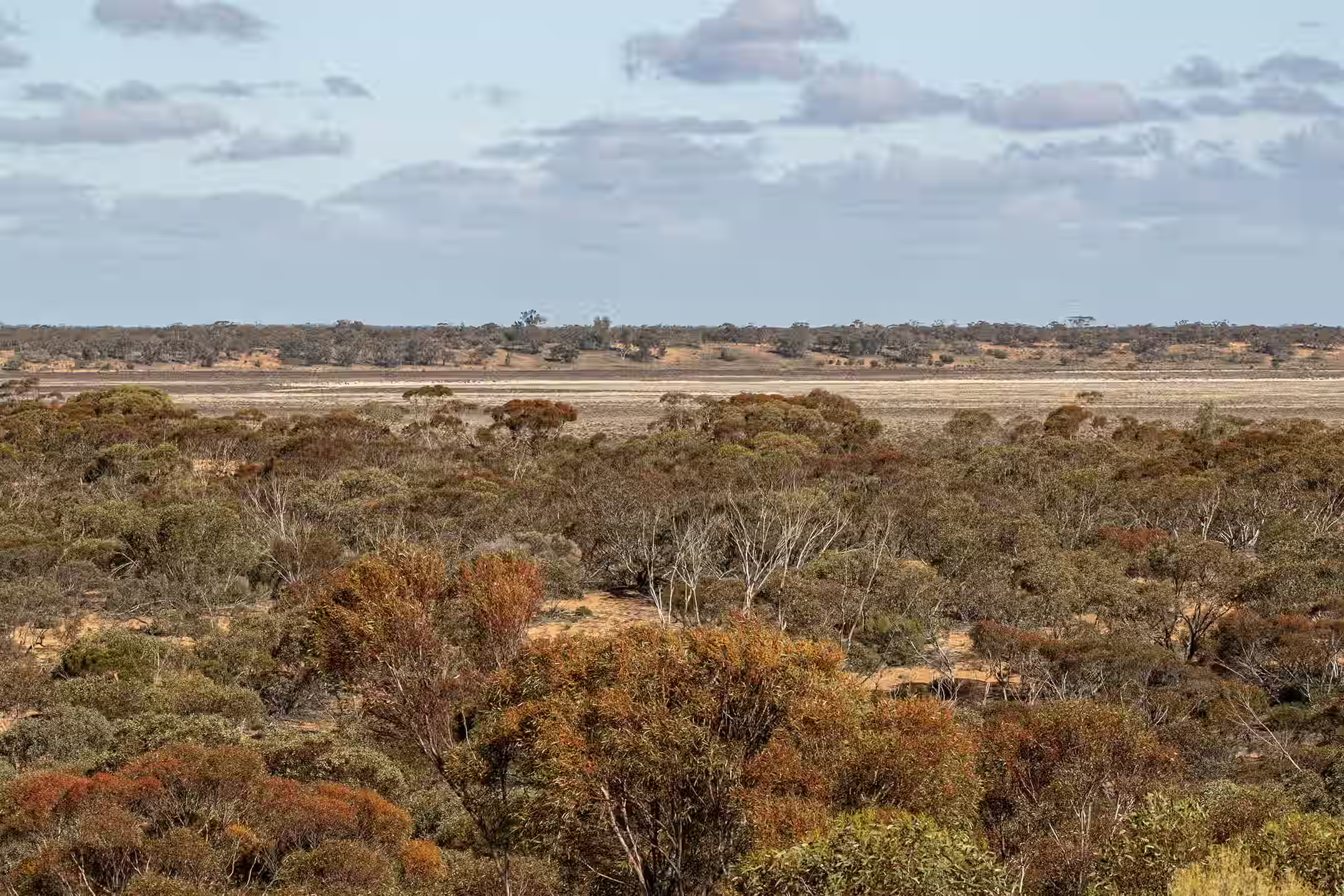

In 2025, ATCW permits for lethal control targeted 230,673 protected Australia native animals, in 2025 the number targeted for lethal control using ATCWs was 2.5 times greater than in 2022
An increase in the population estimate for Grey Kangaroos in Victoria, leading to a 2026 quota of 207,800, a decrease of the commercial quota when compared to 2025 of 22,150 (the commercial component now being 95,450).