2026: Commercial exploitation of Kangaroos in Victoria

Life on land


Your support will assist us to continue our research and content development, the greater our resources, the more we can do.
The more we have an accurate understanding of what is happening to nature, the more we can all do to protect what remains of our living planet.
This is also an opportunity for philanthropists to be part of an ongoing project that tells independent stories about the natural world, stories that will help us to better understand what is happening to species and places on our precious planet Earth.
Note: Creative Cowboy Films does NOT have tax deductible charity status.
Becoming a member of Creative cowboy films The Nature Knowledge Channel is a very real way you can help the precious natural world and support the work we do in creating knowledge about what is happening to it.

The Nature Knowledge Channel is a very real way you can help the precious natural world and support the work we do in creating knowledge about the natural world.
Annual membership of the Creative cowboy films - Nature Knowledge Channel gives you full access to content, stories and films, available on this website. Becoming a member of the Creative cowboy films - Nature Knowledge Channel is a very real way you can help the natural world and support our work in creating a greater understanding about what is happening to it.
A point of difference
Creative cowboy films is independent, is not funded by governments or industry, and is not influenced by their associated interest groups. For reasons of independent research and content development, Creative cowboy films does NOT have tax deductible charity status.
Life on land
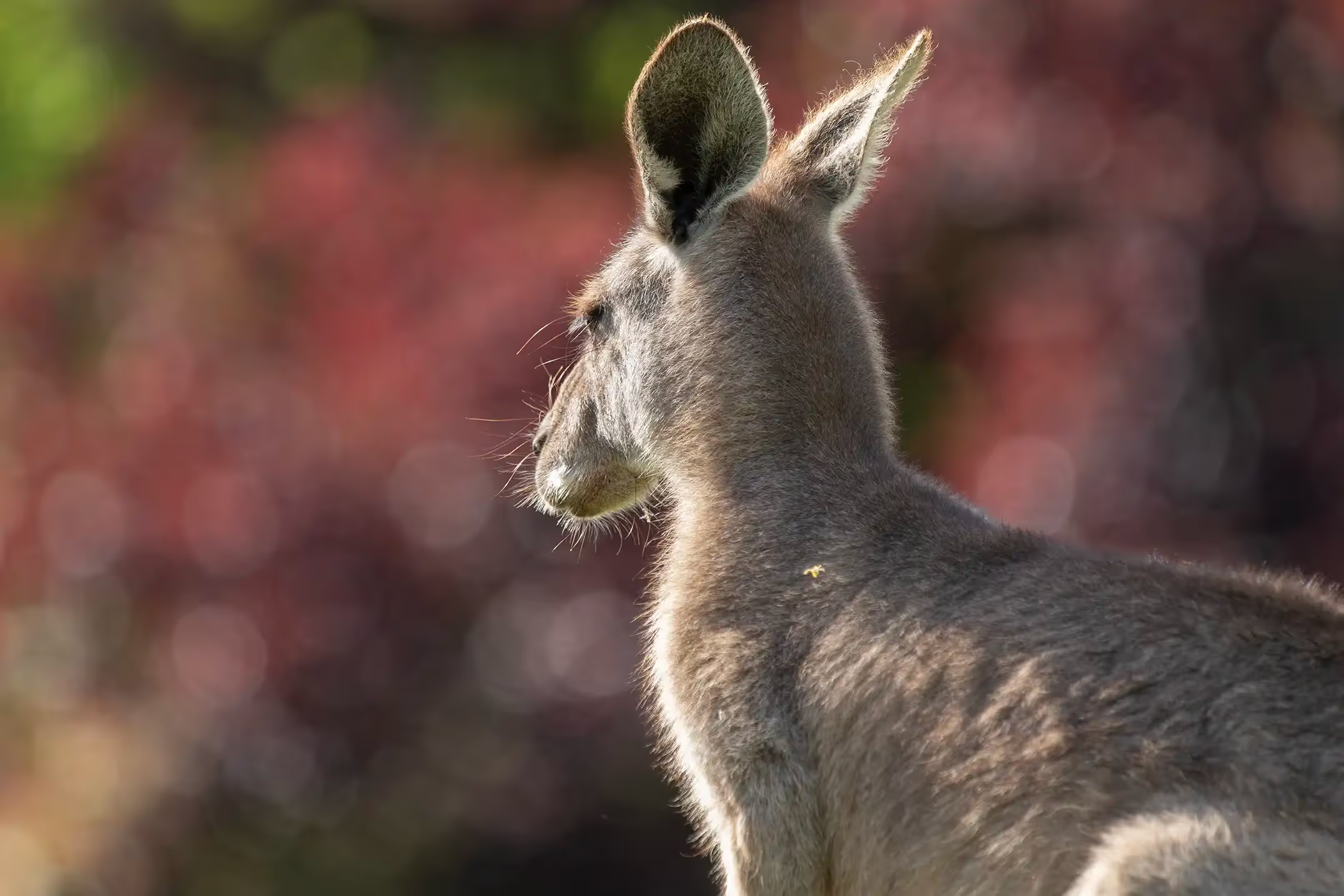
Unless there was a very significant move to kill as many Grey Kangaroos as possible on public land in Victoria by using ATCW permits, these numbers look far too high.
“The total take of Grey Kangaroos during the 2025 calendar year (imputed for the last month) through both the Authority To Control Wildlife (ATCW) permit system and the Kangaroo Harvest Program (KHP) amounted to 257,003 Kangaroos, which was approximately 11.1 per cent of the estimated abundance for 2024 and greater than the recommended 10 per cent total take designated under the Kangaroo Harvest Management Plan (KHMP)”. Victorian Government
“Numbers of Kangaroos of both species controlled under ATCW permit provisions during 2025 were tracking to be the highest on record, likely driven by drought conditions over much of western Victoria. Highest proportional take included Eastern Grey Kangaroos in the Grampians zone (16 per cent) and Western Grey Kangaroos in the Loddon Mallee zone (21 per cent). Although a single year where the total take is above the recommended maximum may not have any detrimental long-term effects….”. Victorian Government
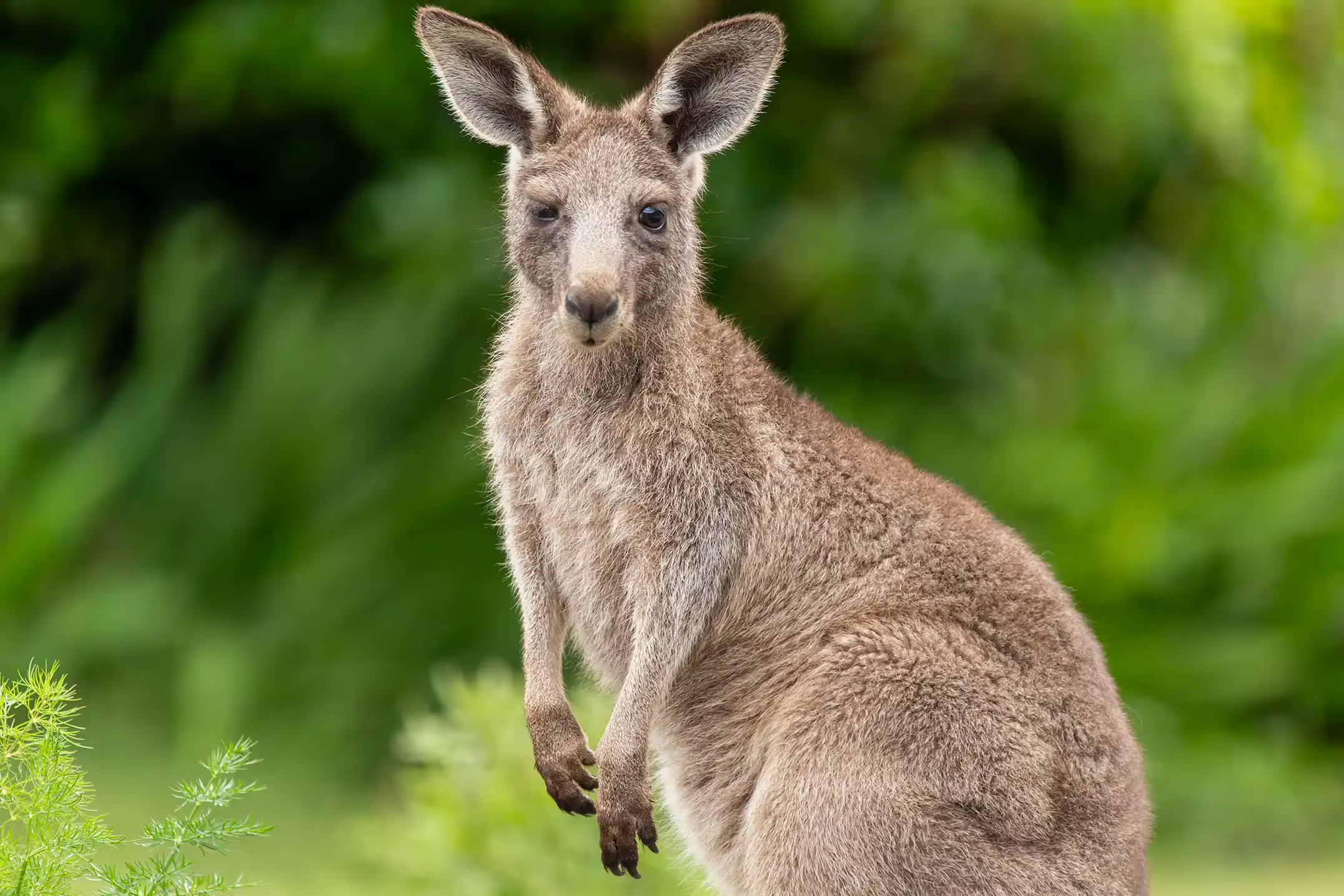
For 2025, the population estimate for Grey Kangaroos in Victoria has risen to 2,306,000 (in 2024 was 2,078,000), an increase in the population of Grey Kangaroos in Victoria over a 12 month period of 228,000.
The increase in the population estimate leading to a 2026 quota for Grey Kangaroos in Victoria of 207,800 (was 236,350 in 2024), a decrease over 2024 of 28,550. The 2026 quota is composed of 21,100 Western Grey Kangaroos and 186,700 Eastern Grey Kangaroos.
The commercial quota for both species is 95,450, composed of 10,850 Western Grey Kangaroos and 84,600 Eastern Grey Kangaroos. That leaves 113,200 Grey Kangaroos which will be targeted using ATCW permits, composed of 11,100 Western Grey Kangaroos and 102,100 Eastern Grey Kangaroos.
Following the catastrophic fires in the Grampians in 2025 a series of requests were made to stop the shooting of Kangaroos in the Grampians and surrounds. Here is the response:
“DEECA considers the types, scale and impact of emergency events on the environment and Grey Kangaroo populations before making decisions on changes to the Kangaroo Harvest Program quota. DEECA assessed the fire footprint which includes areas of the Grampians and Barwon South West ‘harvest’ zones, to date around 3 per cent of the total area of this these ‘harvest’ zones has been impacted by the fire. No changes to the Kangaroo Harvest Program quota are being made at this time”. Victorian Government
Whoops
“Due to the high levels of take of Eastern Grey kangaroos in the Grampians shooting zone and Western Grey kangaroos in the Loddon Mallee shooting zone during 2025, careful management of numbers taken through both ATCW permits and the KHP will be required during 2026 to limit the likelihood of total take exceeding the recommended maximum”. Victorian Government
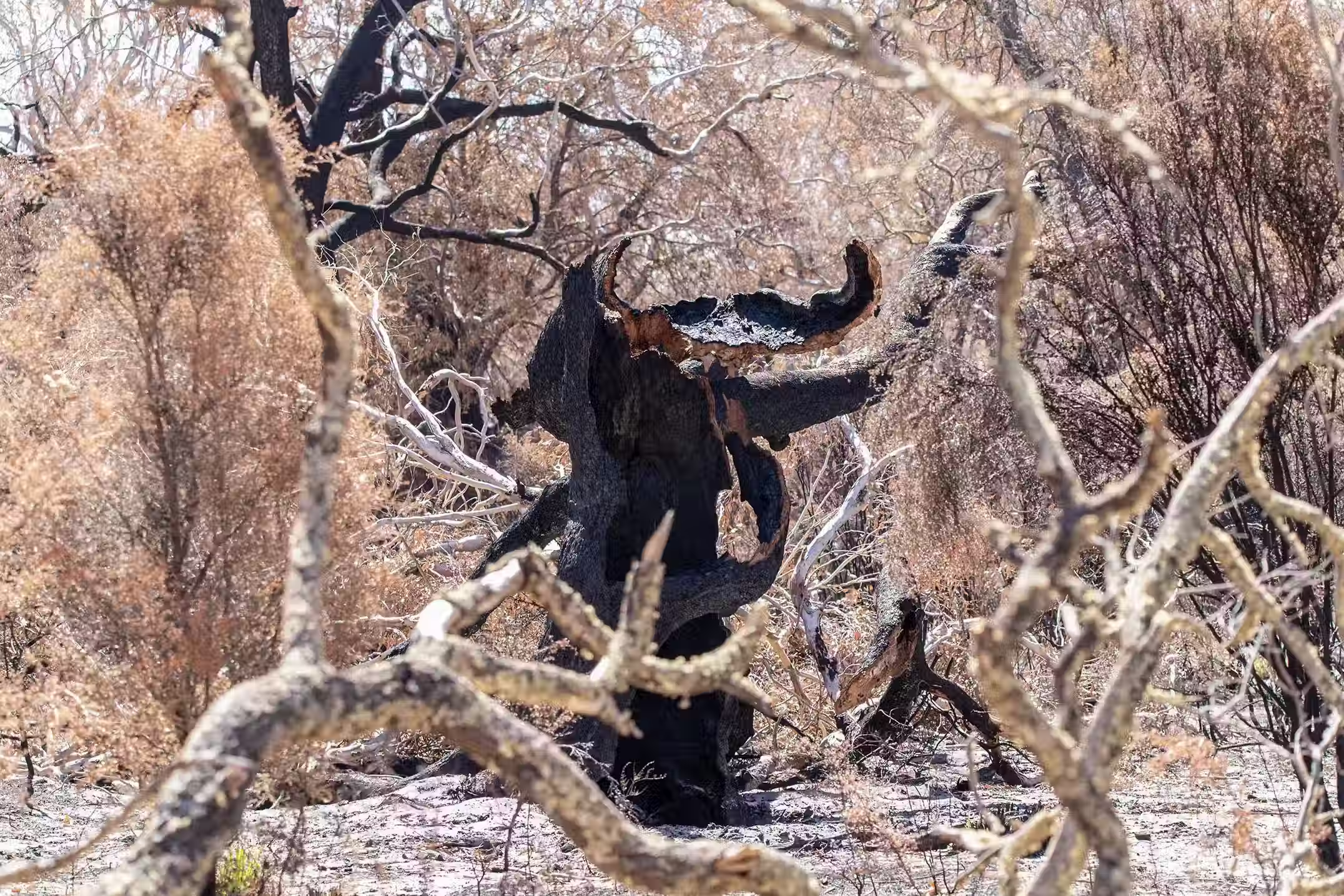
The 2024 population estimate for Western and Eastern Grey Kangaroos in Victoria from which the 2025 quota was derived was 2,078,000, comprised 211,000 Western Grey Kangaroos and 1,867,000 Eastern Grey Kangaroos. This compares with a population estimate of 2,363,850 from the previous survey in 2022.
An 18 per cent increase in the Eastern Grey Kangaroo population in Victoria?
“Comparison of estimates of abundance for 2022 and 2024 (both derived using the new, model-based methodology), points to a change in abundance (across the entire survey area) of Eastern Grey Kangaroos from 1.76 million to 2.09 million between 2022 and 2024. This represents an increase of approximately 18 percent. In comparison, the number of Western Grey Kangaroos decreased slightly, from 227,000 to 212,000, a decline of approximately 7 per cent. For both Grey Kangaroo species, there was substantial overlap between the confidence intervals of the 2022 and 2024 population estimates, meaning certainty in the actual percentage changes in abundance was low”. Victorian Government, December 2024
The number of Kangaroos to be killed in Victoria in 2025 (excludes joeys) was:
The Victorian Government now estimates (last month imputed) that the total commercial take of Grey Kangaroos in Victoria in 2025 was 77,960, composed 75,774 Eastern Grey Kangaroos and 2,186 Western Grey Kangaroos, that is 66.3 per cent of original quota for 2025. This is slightly higher than the Nature Knowledge Channels forecast and it maybe that the reported numbers are overstated.
In the full year 2025, 73,613 Eastern Grey Kangaroos and 2,750 Western Grey Kangaroos were killed for commercial gain in Victoria. The latest Nature Knowledge Channel’s estimate for actual take in the year was 71,000.
The commercial quota for Kangaroos in Victoria for Q3 – 2025 was 32,380. The actual take reported for the period was 13,985 (very similar to Q2 which was 13,886), that is just 43 per cent of the quota for the period. The Q1 actual was 18,311 out of a quota of 37,950.
So for the first three quarters of 2025, the actual take was 46,182 (according to government reports) which was 43 per cent of the original full year quota (against a total monthly consumption figure (tags) of 59,149 for the first three quarters of 2025) against an original full year commercial quota of 106,750.
We are very concerned about the status of the Western Grey Kangaroo in Victoria which is being hunted to extinction in the state and still remains on the commercial list. 633 Western Grey Kangaroos were shot for commercial gain in Q3-2025.
Of the Grey Kangaroos shot in Q3, 7,061 were female meaning that 6,043 young Kangaroos were beaten to death or decapitated (the young are not accounted for in the commercial data). What is extremely concerning for the viability of future Kangaroo populations, given that 50.5 per cent of the commercial take in Q3 were female. This follows a similar pattern to Q2-2025 and is an indicator that Kangaroo populations in the state have plummeted.
We should note the following (when the commercial exploitation of Kangaroos was introduced to Victoria in late 2019 (as a trial in 2014) we were promised that the conditions stated below would not change.
Female Kangaroos with obvious young: Victorian Government conditions
Conditions of Authorisation under section 28A of the Wildlife Act 1975, to hunt, take, destroy, possess, dispose of and sell Eastern Grey Kangaroos and Western Grey Kangaroos in accordance with the approved Victorian Kangaroo Harvest Management Plan 2021-2023.
The conditions required to comply with an authorisation issued under section 28A of the Wildlife Act 1975, to hunt, take, destroy, possess, dispose of and sell Eastern Grey Kangaroos and Western Grey Kangaroos in accordance with the approved Victorian Kangaroo Harvest Management Plan 2021-2023.
NOTE: A reduction in the commercial quota in quarter four 2025 in Victoria to just 5,200 animals, giving a full year quota for 2025 of 94,700. For three out of the now five Victorian shooting zones (following shooting zone amalgamations to make tracking harder), that is, the Gippsland, Hume and Loddon-Mallee shooting zones, the quarter four commercial quota has been set at zero. As we understand it shooting in these three zones will continue using up unused commercial tags and quotas.
We should note that the commercial exploitation of Kangaroos in Victoria requires reporting and tags, so the number of animals killed against quota is tracked. This is quite different to the way in which non-commercial permits to kill Kangaroos and many other species of protected wildlife in Victoria, that is, permits are issued on request with a maximum given number of animals to be killed, beyond that there is no tracking of what actually occurs. What is curious here, in 2025 the Victorian Government issued ATCW permits to kill 179,044 Grey Kangaroos, comprised 158,796 Eastern Grey Kangaroos and 20,248 Westen Grey Kangaroos.
We do not believe that 179,044 Grey Kangaroos were actually killed using ATCW permits and it is not clear from the Victorian Government reporting that the number they are quoting in relation to ATCWs is not an actual. There is something very wrong here.
So we know that Victoria is destroying its Kangaroo populations region by region in the cruellest of ways (young are beaten to death or decapitated and not accounted for in the quotas or actuals).
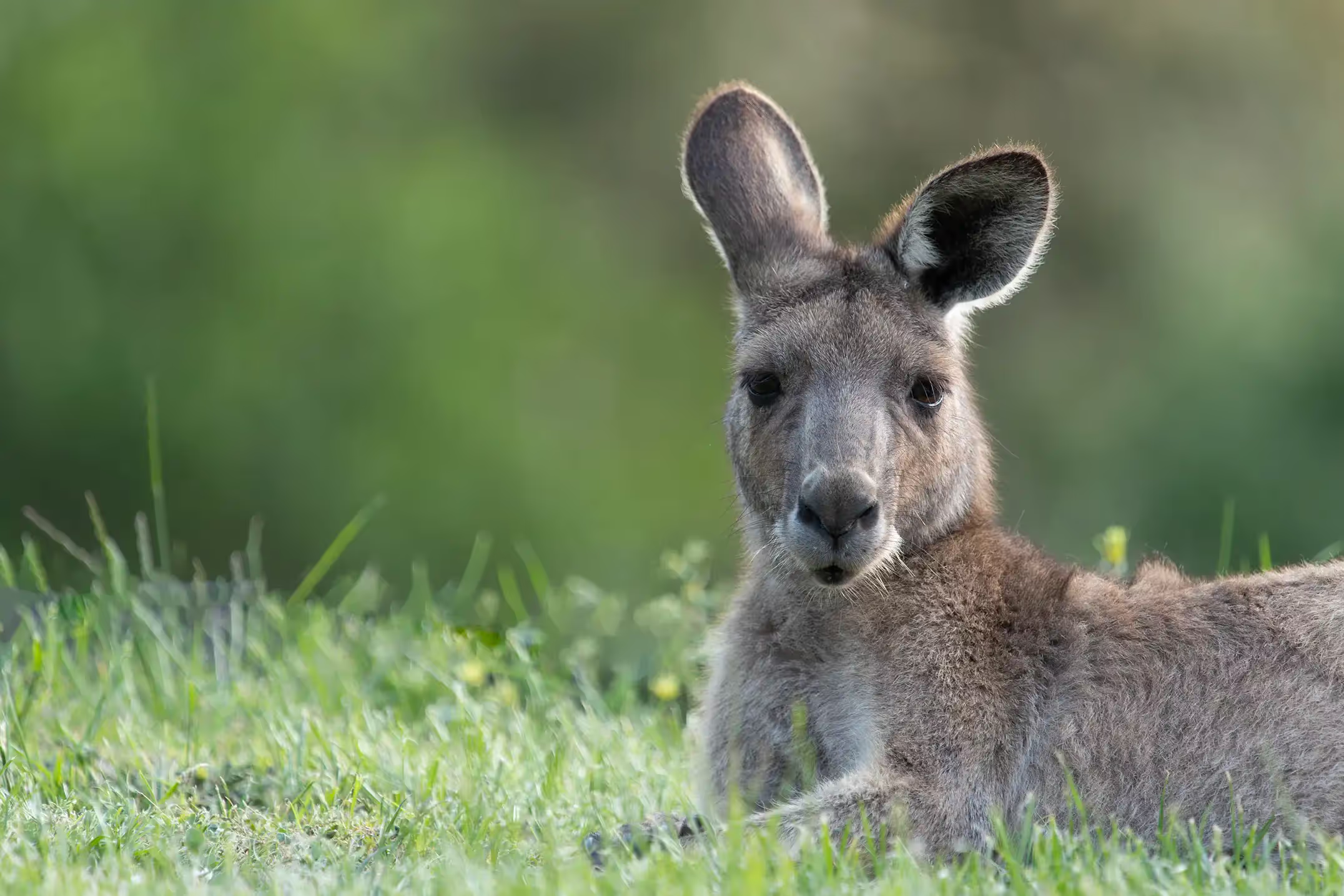
The full year commercial quota in 2024 in Victoria was 155,650. The Nature Knowledge Channel’s latest full year forecast for Victoria in 2024 was 72,800. (originally was 69,900) (the 2023 actual was 72,232).
Full year actual commercial take was higher than expected given numbers provided previously at 81,160 of which 27,314 were females. An additional 23,488 joeys were beaten to death or decapitated, these animals are not included in the annual commercial data.
Because a large number of commercial tags issued by the Victorian Government during the year in 2024 were not utilised, no tags were issued in Quarter 4 in 2024 in any of the 7 Victorian shooting zones.
“On 25 September 2024, DEECA further reduced the quota to 111,175 removing all Quarter 4 allocations. Quota is released in four batches, at the start of every quarter. Where quota is not fully allocated, it can be carried over into the following quarter”. Victorian Government
We should note that the commercial quota for 2024 was revised down to 142,350 Grey Kangaroos in July 2024, a further downward revision occurred in September 2024 to 111,175 (in their Quarter 3 report the Victorian Government states ‘removing all Quarter 4 allocations’). The Victorian Government also states that ‘where the quota is not fully allocated it can be carried over into the following quarter’.
There were 113 shooters commercially exploiting Kangaroos in Victoria in the first half of 2024. In Quarter 3 the number of licensed Kangaroo shooters was 123 of which, 99, received allocations, 61 of which were shooting in the Central and Lower Wimmera shooting zones. In 2024 there are 7 shooting zones, mergers of zones planned from 2025 reduce that to 5 shooting zones.
In the first 6 months of 2024, the Central and the Lower Wimmera shooting zones, at 24,538 Kangaroos, accounted for 68 per cent of all Kangaroos killed for commercial gain in Victoria. In Quarter 3 the Central and the Lower Wimmera shooting zones again led the way in the number of Kangaroos killed for commercial gain at 15,281 (68 per cent) of a total actual for all Victoria of 22,536. Concerningly, these two zones are being merged with zones with low levels of actual take as from January 2025 and vanish, and that makes ongoing comparisons far more difficult.
These young at-foot Kangaroos (approximately to 15 months old) are killed by blunt force trauma (hit with the back of an axe and so on) and bodies are discarded. Adding joeys to the 2024 actual kill during the first 9 months of 2024 raises the total number of Kangaroos killed to 75,153. That is, at foot joeys were 22 per cent of all the Kangaroos killed in Victoria for commercial gain in the first 9 months of 2024, these animals are the next generation of Grey Kangaroos in Victoria.
“Those of us who opposed the slaughter warned that once an industry started, it has its own imperatives and would kill increasing numbers of Kangaroos, even if populations crashed. Even the Queensland Government can claim full marks for its far sightedness on this score, despite its questionable reasoning. It said in 1984, it is important to recognise that while the Kangaroo industry was originally a response to the pest problem caused by these animals it has now come to exist in its own right as the user of a renewable natural resource and thus serves its own interests”. Juliet Gellatley, Kangaroos: myths and realities, AWPC, 2005
Note: Original quotas have been used above for comparison (rather than revised quotas). Not meeting quotas is a sign that population estimates are far too high.
We should note that actual take against quota varies year to year as results are driven by the population estimate and the resulting quota. So a high population estimate which inflates the population, results in a low percentage take against quota. The population estimates, and hence the quotas, are always far too high and Victoria has mastered the art of exaggerating the population estimates.
Since 2014, when the commercial exploitation of Kangaroos was introduced in Victoria, there have been five Victorian Government Kangaroo population surveys which set the quota for the following year. The 2026 population estimates and quotas have been derived from the 2024 survey which therefore determines the ‘recommended maximum’ total take of Grey Kangaroos. The next survey of Kangaroo populations in Victoria is scheduled for last quarter of 2026.
“Aerial surveys of the non-forested parts of Victoria were undertaken during September 2024. These surveys were supplemented with simultaneous ground surveys of the area occupied by both Grey Kangaroo species in order to estimate the proportions of Eastern and Western Grey Kangaroos in each harvest zone”. Victorian Government
"In August 2024 we predicted (prior to the survey) the following, the next survey will have to count, again a rough estimate, around 8,500 Kangaroos to maintain the 2022 population estimate, assuming other model parameters remain the same. So it will be very interesting to see what numbers they come up with. If that does not happen, the government will find the population estimates, on which its mass killing efforts and marketing spin are based, will fall through the floor". Peter Hylands
For the Red Kangaroo the population was estimated to be 39,000 in 2024, down from 54,000 in 2022.
For the welfare and safety of the Kangaroos themselves, the move to public lands in Victoria is the most harmful of all.
“All Kangaroo control on public land currently occurs through Authority to Control Wildlife ATCW authorisations, which are issued to the relevant public land manager. There is no Kangaroo Harvest Program operating on public land at present, however public land managers can choose to access the Kangaroo Harvest Program, any harvesting that occurs on specified public land will be provided for with a separate quota, outside of the quota for the Kangaroo Harvest Program. Any separate quota issued would be a direct replacement to control, that would have otherwise been undertaken under the ATCW system”. Victorian Government, February 2025
In addition to the changes to the way populations are being estimated, including from survey to the methodology and its data, the following changes have occurred.
For Melbourne at least the commercial Kangaroo shooter’s journey from outback to suburbs is over (with the exception of the Yarra Ranges LGA, that is).
The numbers describe allocations that reverse the Victorian Government’s policy of shifting ATCW permits to commercial permits. This reversal of policy also occurred in 2024. While the Victorian Government does not answer the question, we can assume that this is being done to backdoor the commercial killing of Kangaroos into National and State Parks as ‘land managers’ transfer their ATCW permits to commercial. The quantum of this needs to be clarified.
We should note that the Victorian Kangaroo killing system requires that commercial kills are accounted for and reported, ATCW kills, once the ATCW permits are issued, have no reporting requirement. So for ATCW permits issued, the Victorian Government does not have a clue about what actually happened. Failure to meet commercial quotas is very telling, so shifting more permits across to ATCWs means no one knows what actually happened.
“As lethal control is widely used to manage the ecological and economic impacts of Kangaroos, an overarching goal of the plan is to ensure harvesting is ecologically sustainable”. Victorian Government
When asked to provide evidence of the damage that Kangaroos were doing in 2024 the Victorian Government could not supply any evidence of damage caused by Kangaroos:
“You requested the metrics of damage caused by Kangaroos to property. In some areas, wildlife can damage property, farmland or the environment. Wildlife can also pose a threat to human safety or suffer in areas where the species is over-abundant. Wildlife control may be needed to manage the problem. I am unaware of any national or state level statistics of damage caused by wildlife, including Kangaroos, to property on private or public land”. Acting Deputy Secretary, Regional Development and Outdoor Recreation
In 2026
“Harvesters can apply for a quota allocation in any zone. The allocation will specify how many and what species of Kangaroos they can harvest, and in which zones. Tags (with quota ID) are then posted to harvesters for attaching to Kangaroos at the time of harvesting. Changes have been made to the process for allocating quota in 2026. These changes have been made to help improve the utilisation of tags throughout the year and prevent high numbers of tags sitting with harvesters who are not actively harvesting. The first change is to decrease the maximum tag allowance for non-active harvesters from 50 to 25 while the second change is to provide for the cancellation of unused tags after three months. Where unused tags are cancelled after three months, tags will be transferred back into the quota for further allocation to active harvesters”. Victorian Government
Correction factors appear to have vanished? Well perhaps not, methodologies may differ in application but raw counts of Kangaroos are corrected by applying the detection probability principle, thus correcting the raw count from aircraft via what is called distance sampling. That is, for distances further from the aircraft within certain parameters, additional and unseen Kangaroos are added. These adjusted numbers are the ones that drive the modelling of the population estimate. These corrected survey numbers are then extrapolated across similar habitat and landscape types. As a general comment, a compounding factor that makes population estimates more and more inaccurate is when transects between different survey periods are changed or deleted. If this does occur (and changes have occurred between surveys) there is a danger of these changes becoming a fishing expedition to find Kangaroos away from the original transect where Kangaroos have vanished. Hence zero has been replaced by a number from the new transect or deleted entirely and one problem here is that applying a correction factor or detection probability to zero gives an answer of zero, not helpful if you are trying to demonstrate sustainability. The bottom line here is survey methods need to be constant between surveys to ensure scientific integrity.
Cooking up the population numbers, so they tell you there are plenty of these animals left in Victoria and they won’t become extinct. Well think again.
Sadly, since British settlement, 7 species in this family have become extinct in Victoria. And even more sadly, attitudes and conduct have not changed and more species will follow.
The existential problem the Victorian Government has in spruiking its inflated Kangaroo population numbers year on year is that Kangaroos are actually vanishing from Victoria, region by region. So sooner, rather than later, the truth is revealed as the South Australian Government is about to find out. In the interim, creativity is required to prop up the numbers, including by what state governments in Australia describe as science. There are a number of unanswered questions in Victoria relating to surveys, the steep increase in the number of Kangaroos counted in the 2024 survey for example aligned with yet another change in methodology, amalgamating shooting zones, moving to include public land, and various claims and resulting shifts in policy, the move back to unaccounted for ATCWs is one example here. Recent bounties in South Australia and Victoria are an indicator of trying to prop something up and not of abundance and represent misconduct in relation to government expenditures.
“I can confirm that ATCW numbers reported always represent the maximum number of animals (wildlife) authorised for control by ATCWs that have been issued within a specified period. The actual number of animals that are controlled under each authorisation may be lower. You are correct that persons who hold an ATCW are not required to report actual numbers controlled under each ATCW”. Victorian Government 23 December 2025
One of the remarkable things here is that the 257,004 Kangaroos the Victorian Government is claiming that were killed under its behest and promotion, including additional funding, are part of the 1.1 million protected Australian wild animals (around 70 species) killed in Victoria in 2025. This is going on at the same time as the Victorian Government’s long delayed report on its Inquiry into Ecosystem Decline in Victoria was published and the Australian Government’s long delayed action in updating its Environment Protection and Biodiversity Conservation Act 1999, both of which we spent a great deal of time on. Neither of these Inquiries and the subsequent actions from each of these governments will save a single one of the 1.1 million native animals (around 5 million Australia wide) and the many more to come protected Australian native animals killed this year and in future years under government programs.
In 2026, Commercial and ATCW permits combined, show that the total allowed take in the Loddon Mallee Shooting Zone is 49,500 (both Grey species) which given the large number of females now being killed in Victoria, would mean an additional 18,000 joeys would also be killed. Replacement rate in the zone would now be well below one.
The actual take of Grey Kangaroos in the Loddon Mallee Shooting Zone in 2025 was, for commercial 18,933 (quota was 28,650 not including joeys) and via ATCWs the government claim that 22,900 were killed (not including joeys) but this number is unknown as the government does not track outcomes for ATCWs. So the maximum number of Grey Kangaroos killed (according to the Victorian Government) in 2025 in the zone was 41,833 plus a further unaccounted for number of joeys at around 13,000 to 14,000. The combined commercial and ATCW quota for 2025 in the zone was 49,500 (plus an unaccounted for 15,500 joeys). Our view is that what actually occurred, despite the claims, is that the maximum kill via ATCWs in the zone in 2025 was 15,000. So the probability is, that all up, 34,000 Kangaroos were killed by government behest in 2025 (plus10,500 unaccounted for joeys). The significant shortfall in the actual kill came despite Victorian Government subsidies to enable and encourage the killing of more and more Kangaroos in the state.
We keep saying it, but you can’t actually kill what does not exist.
We should note that, during 2025, the total take of Western Greys in this zone was 17 per cent of the Victorian Government’s estimated population, itself significant overstated, meaning that the total take share of the population killed would be far higher than 17 per cent. This represents the number of Kangaroos approved for control under ATCW permits. Almost all of the permits issued for Western Grey Kangaroos in the zone in 2025 were ATCWs. There are now far fewer Western Grey Kangaroos in Victoria than the Victorian Government pretends, conduct here making the actual numbers impossible to track, describes that this is indeed the case.
Prior to 2024, the Campaspe Shire was in the North East Shooting Zone, which from 2025 was merged to form the Loddon Mallee Shooting Zone, thereby converting the more-fine-grain analysis to a vast region, making it far harder to track what is actually occurring in that zone. We do know that the Victorian Government is well on the way to driving both the Red Kangaroo (via ATCWs) and the Western Grey Kangaroo (via commercial and ATCWs) to extinction in the state and much of what is occurring here is in the Loddon Mallee Shooting Zone.

The Queensland Government’s population estimate for the 3 commercially exploited species in Queensland's 5 commercial shooting zones is 19,308,148 giving a commercial quota in 2026 of 2,850,900 with a DMP quota of 386,164.
The population estimate for Kangaroos in New South Wales has fallen to 9,586,809 from 13,910,688, resulting in a decline in commercial quota for 2026 of 733,927 Kangaroos.
This analysis is a rebuild of annual Kangaroo population estimates, commercial quotas and actual take from 1980, including the population estimate data removed from the public gaze.
Evacuated and glad to be returning home to Wongaburra, Christine Corbidge talks about her life with her horses and the wildlife she loves.
As fires in Victoria rage, how many native animals are being rescued from public lands? This is the timeline of the Grampians Gariwerd fires.
In February 2024 I found myself in the footsteps of Dr Jim Cairns (former deputy PM) in precisely the same venue, the Melbourne Town Hall, and talking about precisely the same topic, Kangaroos.
This story attempts to piece together the history of mass killing of native Australian species in State and National Parks in Victoria. Over 100,000 Kangaroos have been targeted since 1984, when the killing began.
So we tell stories about Kangaroos around the world as we work to bring some justice and peace and the right for these beautiful animals to live their lives, free of the cruelties they now endure.
Our experience of South Australian landscapes is one of total absence. The myths of booming populations and mass starvation, are precisely that, myths. The population estimates for 2026 show a 31 per cent decline in the population of Red Kangaroos.
While we wait for the 2026 population estimates and commercial quotas (from 2025 surveys) here is the history of exploitation of Kangaroos in Western Australia.
As of 10 January 2026 all state governments, except Western Australia, had provided their data. Here is the summary so far giving a population decline of 5,799,589.