2026: Commercial exploitation of Kangaroos in New South Wales

Life on land


Your support will assist us to continue our research and content development, the greater our resources, the more we can do.
The more we have an accurate understanding of what is happening to nature, the more we can all do to protect what remains of our living planet.
This is also an opportunity for philanthropists to be part of an ongoing project that tells independent stories about the natural world, stories that will help us to better understand what is happening to species and places on our precious planet Earth.
Note: Creative Cowboy Films does NOT have tax deductible charity status.
Becoming a member of Creative cowboy films The Nature Knowledge Channel is a very real way you can help the precious natural world and support the work we do in creating knowledge about what is happening to it.

The Nature Knowledge Channel is a very real way you can help the precious natural world and support the work we do in creating knowledge about the natural world.
Annual membership of the Creative cowboy films - Nature Knowledge Channel gives you full access to content, stories and films, available on this website. Becoming a member of the Creative cowboy films - Nature Knowledge Channel is a very real way you can help the natural world and support our work in creating a greater understanding about what is happening to it.
A point of difference
Creative cowboy films is independent, is not funded by governments or industry, and is not influenced by their associated interest groups. For reasons of independent research and content development, Creative cowboy films does NOT have tax deductible charity status.
Life on land
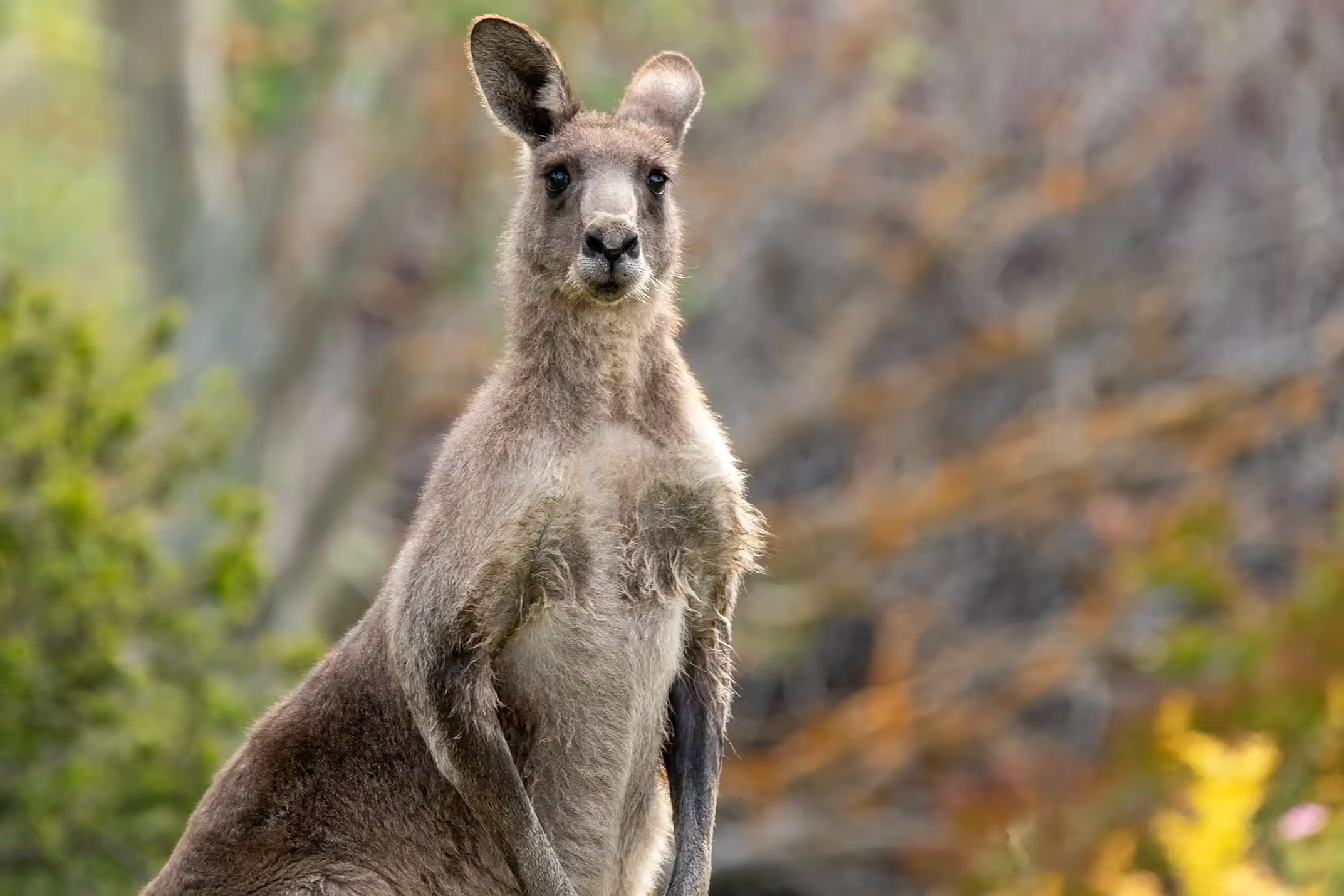
The absurdity of the New South Wales Government’s Kangaroo population estimates and resulting quotas is described by this calculation. Our estimate for actual total commercial take all Australian mainland for 2025 now sits at around 1,350,000 animals. Our estimate for the shortfall of take against quota in New South Wales alone is currently 1,611,950, that is, the shortfall of actual take against quota in New South Wales in 2025 is 261,950 more than the actual commercial take for all Australia.
We say the same thing each and every year. To describe some of the absurdity of the population estimates, here is just one example, this time in the Griffith North shooting zone and population estimates for the Red Kangaroo.
So we get a near ten-fold increase in the population in 12 months, that is an increase of 341,952, when the maximum possible assuming the Kangaroos all led a peaceful and safe existence (the very opposite is the case) is 3,600. So where did the additional 338,352 Red Kangaroos come from?
For 2025, the population estimate for Kangaroos in New South Wales has fallen to 9,586,809 (in 2024 was 13,910,688 ), a decrease in the population of Kangaroos in New South Wales over a 12 month period of 4,323,879 (in 2024 biologically impossible increase in the population estimate was 4,275,788).
This decline in the population estimate leading to a 2026 commercial quota for Kangaroos in New South Wales of 1,453,025 (was 2,186,952 in 2025 and 1,484,072 in 2024), a decrease of 733,927 (in 2025 quotas increased by 702,880 over the previous year. For 2026 there is also a special quota of 143,802 (was 208,659 in 2025, up from 144,523 in 2024).
“In 2026, the harvesting of Grey Kangaroos is suspended in the Bourke and Broken Hill shooting zones and reduced to 10 per cent of the estimated populations in the Coonabarabran and Narrabri shooting zones. The ‘harvesting’ of Wallaroos is suspended in the Armidale shooting zone and reduced to 10 per cent of the estimated population in the Upper Hunter shooting zone. All other shooting zones are open to ‘harvesting’ with quotas set at the usual 17 per cent (for Red Kangaroos) or 15 per cent (for Grey Kangaroos and Wallaroos) of the estimated populations”. Government of New South Wales
For each species the commercial quota (includes special quota) for 2026 is:
“Population estimates from 2025 aerial surveys, and 2023 and 2024 where relevant, of the 4 commercially ‘harvested’ Kangaroo species across survey regions. Population estimates from 2025 surveys in the Northern Tablelands regions were used for the Wallaroo”. Government of New South Wales
The actual commercial Kangaroo kill in the first two months of 2026 was 99,473, that is 7 per cent of the annual quota for 2026. Species with highest actual kill were the Eastern Grey Kangaroo at 53,909, 6 per cent of the annual quota, and the Red Kangaroo at 40,638, 8 per cent of the annual quota.
If we compare the first two month’s data with the outcome in 2025 - The actual commercial Kangaroo kill in the first two months of 2025 was 92,707, that is 4 per cent of the larger annual quota for 2025. Species with highest actual kill were the Eastern Grey Kangaroo at 43,052, 4 per cent of the larger annual quota for that year, and the Red Kangaroo at 41,662, 5 per cent of the larger annual quota.
The kill in January and February 2026 was 6,766 higher than in 2025.
For 2024, the population estimate for Kangaroos in New South Wales rose to 13,910,688 (in 2023 was 9,634,900), a biologically impossible estimated increase in the population of Kangaroos in New South Wales over a 12 month period of 4,275,788.
This increase leading to a commercial quota for Kangaroos in New South Wales in 2025 of 2,186,952 (in 2024 it was1,484,072), an increase of 702,880. For 2025 there was also a special quota of 208,659, up from 144,523 in 2024.
For each species the commercial quota for 2025 is:
As commercial shooting zones in New South Wales expand, shooting now occurs across 15 shooting zones covering the entire state with the exception of the coastal strip. The cost of the population surveys annually is approximately in the range of $400,000 to $500,000. This does not include other ‘management’ and ‘marketing’ costs which are far more significant.
The gross value of the commercial exploitation of Kangaroos in New South Wales at current prices is approximately $12.25 million (2024 estimate). Costs imposed on other sectors, including tourism, costs of human harms and consequential loss are significant and not accounted for.
In 2025 the actual commercial kill was 634,087 (29 per cent of original quota) Kangaroos across all species and zones. In 2025 , there were no reduced or suspended quotas in any zone. The actual commercial kill in 2025 was higher than the earlier estimates which indicated that 545,000 Kangaroos would be killed for commercial gain. The original commercial quota for 2025 was 2,186,952 Kangaroos.
The 2025 commercial actual kill was higher than in 2024 when the actual kill (now adjusted from earlier reports) was 544,317 Kangaroos.
In 2025, the actual commercial kill by species was:
During 2025, commercial kill licence conditions required that Kangaroo carcasses delivered to chillers for sale were not to weigh less than 14 kilograms dressed weight or less than 20 kilograms undressed weight. Before1 January 2008, the minimum carcass weights were 12 and 13 kilograms dressed and undressed, respectively. The New South Wales Government says:
“Data collected from shooter returns during 2025 indicatethe average carcass weight across all species was 29.5 kilograms for males and19.5 kilograms for females, higher than the long-term averages, likely to be becauseof the increase in minimum carcass weight requirements made to licence conditions. The New South Wales Government does not require licensees to recordi ndividual carcass weights”.
In 2025, licences to harm protected native animals were issued to kill 439,620 Kangaroos within the commercial shooting zones, the majority of regions in which Kangaroos live (excluding national parks). Licensees who submitted reports by early May 2026, reported 187,220 Kangaroos were killed in 2025, these licences were to kill 321,917 (73 per cent of total harms) Kangaroos giving a shortfall of 134,697 animals. A number of licensees had not reported at the time of writing, with this group of licences authorising the killing of up to 117,703 Kangaroos.
The population estimate of the four commercial species in 2023, from which the 2024 quota is derived, was 9,634,900 (down from 11,882,215 in the previous year).
For all species exploited commercially in New South Wales, that is, the Eastern Grey Kangaroo, Red Kangaroo, Western Grey Kangaroo and Wallaroo, the actual take in the first 9 months of 2024 was 396,666 against a full year quota of 1,484,072. That is 27 per cent of the full year quota. By mid-November 2024 the actual, as reported, had risen to 450,418, from 565,229 allocated commercial tags. By year end 2024 the actual take was 544,317.
As the New South Wales Government’s population estimates for 2023 showed significant decline compared to the previous year, the ABC, Australia’s public broadcaster, claimed the following:
“Kangaroo numbers in the state's west are exploding, and farmers aren't able to get harvesters out to shoot enough of them”.
We should note that the ABC has not reported the significant decline in the New South Wales Government’s population estimates for Kangaroos in the most recent 12 month period.
We can celebrate 55 years of ABC Kangaroo nonsense. Why do they do it and why do they repeat the same stories every year? Who knows, but what it is, is very poor and irresponsible journalism, that harms both animals and the people who care about them.
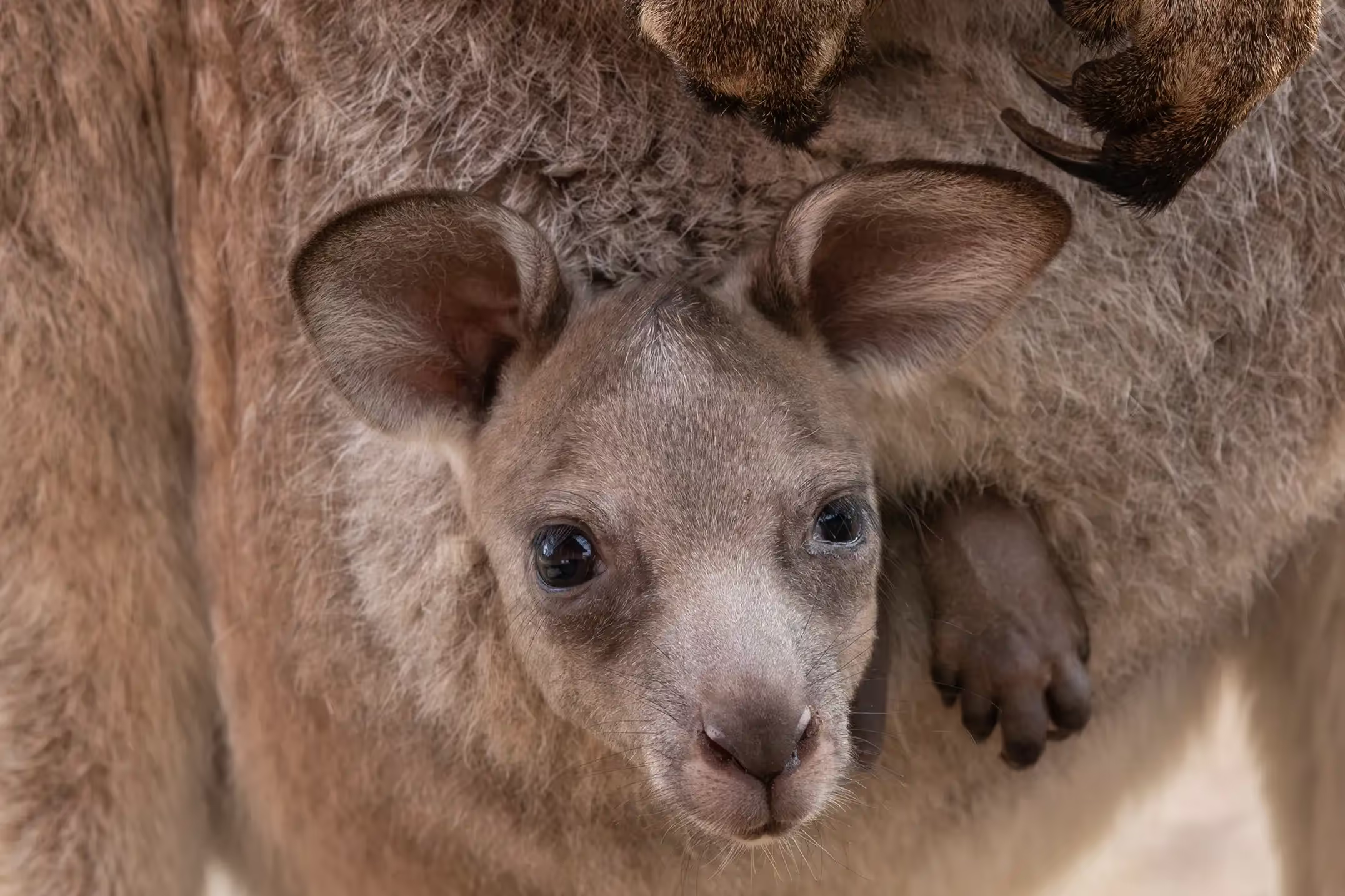
The Government of New South Wales describes the changes in survey methodologies since 2001. We should also note the significant expansions of commercial shooting zones in New South Wales.

In 2024, the New South Wales Government claim an increase in Kangaroo populations that is impossible. This population estimate sets the quota for 2025.
What happened, the New South Wales Government Inquiry into the Health and wellbeing of Kangaroos and other Macropods in New South Wales?
Total actual take in the first 9 months – 466,446 (21 per cent of full year quota). This compares to an actual take in the first 9 months of 2024 of 396,666.
This analysis is a rebuild of annual Kangaroo population estimates, commercial quotas and actual take from 1980, including the population estimate data removed from the public gaze.
The Queensland Government’s population estimate for the 3 commercially exploited species in Queensland's 5 commercial shooting zones is 19,308,148 giving a commercial quota in 2026 of 2,850,900 with a DMP quota of 386,164.
An increase in the population estimate for Grey Kangaroos in Victoria, leading to a 2026 quota of 207,800, a decrease of the commercial quota when compared to 2025 of 22,150 (the commercial component now being 95,450).
Our experience of South Australian landscapes is one of total absence. The myths of booming populations and mass starvation, are precisely that, myths. The population estimates for 2026 show a 31 per cent decline in the population of Red Kangaroos.
While we wait for the 2026 population estimates and commercial quotas (from 2025 surveys) here is the history of exploitation of Kangaroos in Western Australia.
As of 10 January 2026 all state governments, except Western Australia, had provided their data. Here is the summary so far giving a population decline of 5,799,589.