Australian Macropod meat exports to the world: 2017 to 2025

Life on land


Your support will assist us to continue our research and content development, the greater our resources, the more we can do.
The more we have an accurate understanding of what is happening to nature, the more we can all do to protect what remains of our living planet.
This is also an opportunity for philanthropists to be part of an ongoing project that tells independent stories about the natural world, stories that will help us to better understand what is happening to species and places on our precious planet Earth.
Note: Creative Cowboy Films does NOT have tax deductible charity status.
Becoming a member of Creative cowboy films The Nature Knowledge Channel is a very real way you can help the precious natural world and support the work we do in creating knowledge about what is happening to it.

The Nature Knowledge Channel is a very real way you can help the precious natural world and support the work we do in creating knowledge about the natural world.
Annual membership of the Creative cowboy films - Nature Knowledge Channel gives you full access to content, stories and films, available on this website. Becoming a member of the Creative cowboy films - Nature Knowledge Channel is a very real way you can help the natural world and support our work in creating a greater understanding about what is happening to it.
A point of difference
Creative cowboy films is independent, is not funded by governments or industry, and is not influenced by their associated interest groups. For reasons of independent research and content development, Creative cowboy films does NOT have tax deductible charity status.
Life on land
Our thanks to Mehreen Faruqi, Deputy Leader of the Australian Greens, Senator for NSW.
Kangaroo meat is marketed as a high-quality, lean, and novel protein source for pets and humans, particularly in Australia. However, its use in pet food has been linked to significant safety incidents and health risks, ranging from nutritional deficiencies to fatal toxification. From paddock to table or dog bowl, the lack of strict regulation in the raw ‘pet meat’ industry in some regions has been highlighted as a hazard including butchering in the wild and transport related issues.
The graphs summarise the quantity and value (in $AUD) of exports of Kangaroo meat (fresh, chilled or frozen meat and edible meat offal), to the country of destination and by calendar year (2017 to 2023). The data has been sourced from the Australian Bureau of Statistics (ABS) Catalogue 9920.0. The data includes all Kangaroo products exported under tariff code 0208.90.11


Kangaroo meat imported into Papua New Guinea is much more likely to end up as meat consumed by humans. What is noteworthy is the deferential in price per kilo when the European Union and Papua New Guinea are compared? Why is there such a substantial difference in pricing?
Given the issues relating to refrigeration and transport in the hot tropics when combined with other heath related risks of this trade, we should ask ourselves is this sensible?
“During the outbreak of toxoplasmosis in 1994 (incorrectly listed as 1993 in the Food Standards Australia New Zealand (FSANZ) report) there were 13 cases of infection (from eating Kangaroo meat). There were no deaths. Symptoms included myalgia, headache, lethargy, fever, chills lymphadenopathy. Four of the 13 cases had no symptoms. The cases are detailed in the Department of Health's journal Communicable Diseases Intelligence”. Australian Senate
“An outbreak of Salmonellosis occurred in August 2024 after consuming wild hunted Kangaroo in a remote area of the Northern Territory (NT), Australia…..All seven cases consumed the same meal – a single, locally hunted and butchered Kangaroo. Contamination likely occurred due to unsafe butchering, storage, transportation and insufficient cooking of the meat. This outbreak highlights the risks of contamination of game meat (in this case Kangaroo) with Salmonella”. Australian Centre for Disease Control, Australian Government
“Q fever is a re-emerging pathogen of increasing public health importance. This zoonosis, caused by Coxiella burnetii, can lead to acute and chronic illnesses in humans. While many infections are mild or asymptomatic, severe illness requiring hospitalisation and death can occur…..Domestic cattle, sheep and goats are important reservoirs for C. burnetii and exposure to aerosols and dust generated from infected animals is a well-established risk factor. Of particular importance in transmission are the birth products of ruminants, which contain extremely high concentrations of C. burnetii. Typical high risk occupations associated with Q fever infection include farming, abattoir work and veterinary practice. Domestic pets, wild animals and ticks are also important reservoirs, although the role they play in the transmission of human disease is not well understood. In Australia, Bandicoots, Kangaroos, Possums, Dingoes, Cats, Foxes and wild Pigs have all shown serological evidence of C. burnetii infection”. Department of Health and Agre Care, Australian Government

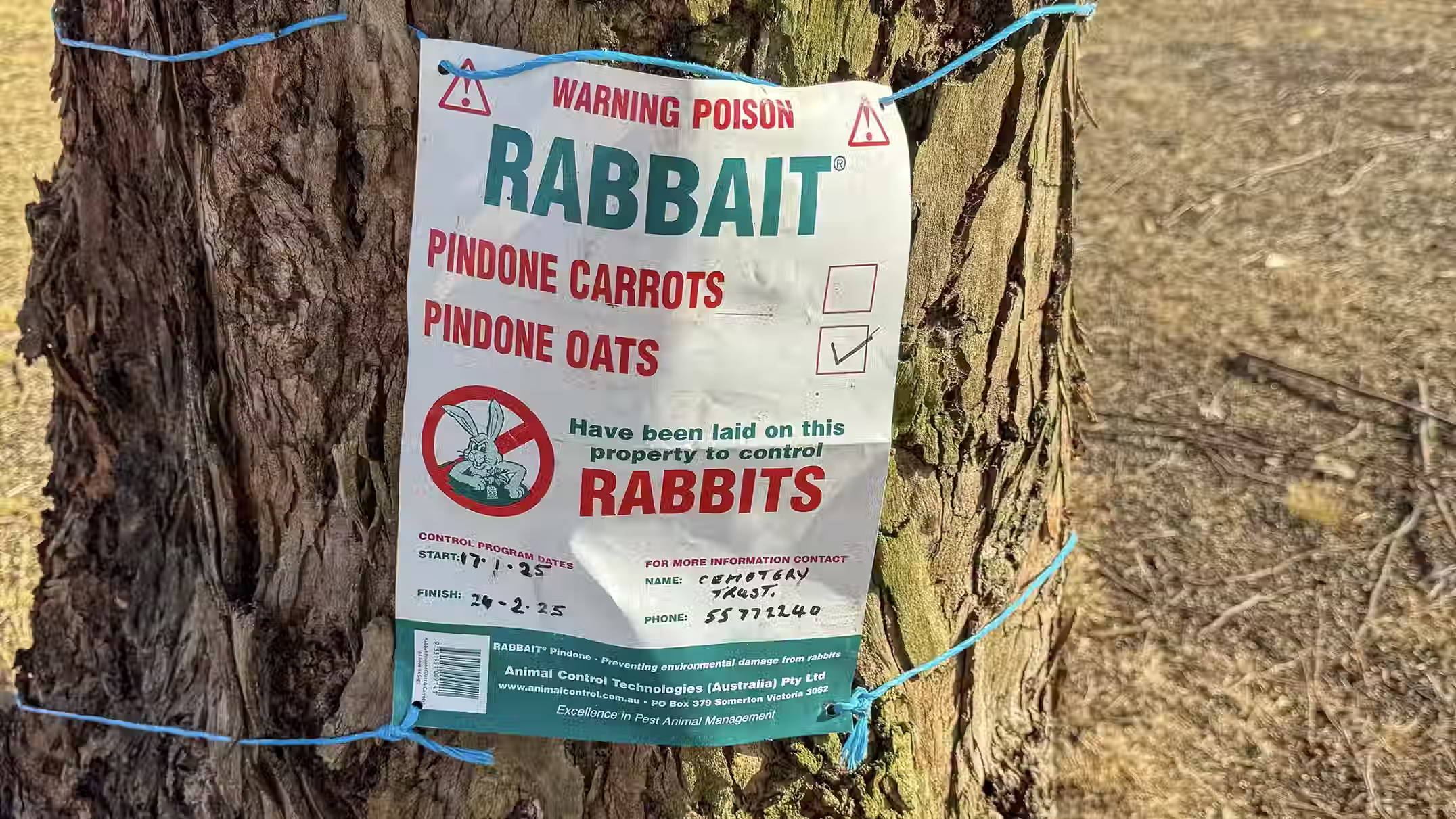
It is deeply shocking that Pindone carrots can be laid along a public roadside adjoining a school and in precisely the same place as commercial Kangaroo shooters operate.
As of 10 January 2026 all state governments, except Western Australia, had provided their data. Here is the summary so far giving a population decline of 5,799,589.
This analysis is a rebuild of annual Kangaroo population estimates, commercial quotas and actual take from 1980, including the population estimate data removed from the public gaze.
Years of effort from the Kangaroos are not shoes team scores again.